The Choice is Ours

Fork-in-The-Road     Every day we get to make choices.  We make choices about what we eat, where we go, what we see, and what we do.  Many of the choices we make seem to only be for that moment, and then they are gone.  Others affect us for the rest of our lives.

     Consider the choice that was put before the Israelites just before they were to go into the Promised Land.  God through Moses told the people that they had a choice before them.  They could choose life and good, or they could choose death and evil (Deuteronomy 30:15).  God was not going to force them to be good or to choose the right path.  The choice was theirs.

     If they chose to do what was right, “. . . to love the Lord your God, to walk in His ways, and to keep His commandments, His statutes, and His judgments . . .” (Deuteronomy 30:16 NKJV), then they could stay in the land that was promised to their fathers forever.  However, if they chose to do that which was against God’s commands, and decided to worship other gods, then they would not be allowed to remain in that land (Deuteronomy 30:17-18).  Ultimately we know what choice they made.  They constantly went after other gods, and their idolatry led to them being taken away in the Babylonian captivity.  Thus, although a remnant returned to that land, they broke their part of the covenant relationship with God and lost the Promised Land.

     We equally have a choice before us.  Will we choose to follow God and make it to the Promised Land of heaven, or will we go our own way and lose out?  Jesus said, “I am the way, the truth, and the life. No one comes to the Father except through Me” (John 14:6).  In order to go to God, we must go through Jesus.  The choice is ours.  Our choices have consequences.  Let us therefore choose wisely!

Life Is In The Blood

George Washington     In December 1799 George Washington passed from this life.  He had been out taking care of his property in foul weather and had come down with what would appear to be a cold (sore throat, congestion, etc.).  In an effort to save the former president, his doctors took to opening veins and “bleeding” him, which was believed at the time to be the way to get the illness out of his system.  What the doctors of the time failed to realize is that life is in the blood.

     Man cannot sustain his physical life without blood.  This was well known to the Israelites, or should have been, since God forbade the eating of blood because “life is in the blood. . .” (Leviticus 17:11a NKJV).  Human medicine has come to realize the importance of blood in sustaining life in the years following Washington’s death.  Now, much can be done with transfusions to help stabilize patients who have suffered a loss of blood.

     In looking at man’s spiritual life, it can be seen that our spiritual life is also in the blood.  The Scriptures tell us that we have all sinned (Romans 3:23), and that the wages, the anticipated payment, of sin is spiritual death (Romans 6:23).  We know that this is not in reference to physical death, for we must all be subject to that unless the Lord returns first (Hebrews 9:27).  In order to have spiritual life, an eternity in heaven, we must have our sins covered by the blood of Christ (1 John 1:7; Revelation 1:5).

     We make contact with the blood of Christ when we are buried with Him in the act of baptism (Romans 6:3-4).  In obeying the command of Christ to be baptized (Mark 16:16), we can have our sins washed away (Acts 2:38; 22:16).  It is in our obedience to the words of Scripture, that the blood of Christ is applied to us and we are cleansed from our sins.  Thus, we are able to have spiritual life.  Thus, both our physical life and our spiritual life are in the blood!

Nebuchadnezzar’s Wise Men

CrystalBall_thumb      Perhaps you have heard of or seen a magician, who as part of their act reads the mind of a member of the audience.  If so, you know how impressive this seems on the surface.  Just how is it that a man can read the thoughts of another human being?  Later, when you find that there is some sort of trick or gimmick to explain the ‘magic,’ you realize that man just does not have the ability to read minds.  This, however, is not a new discovery.

     In the second chapter of the book of Daniel, we have recorded for us that Nebuchadnezzar, the king of Babylon, had a most troubling dream.  He called for all of his wise men to come to him and tell him what the dream was and what it meant.  The wise men of Babylon were perplexed.  Without any sort of clues, or without Nebuchadnezzar telling them about the dream, there was no way for them to determine what the dream even was, not to mention what it might have meant.  They correctly stated that, “There is not a man on earth who can tell the king’s matter; therefore no king, lord, or ruler has ever asked such things of any magician, astrologer, or Chaldean.  It is a difficult thing that the king requests, and there is no other who can tell it to the king except the gods, whose dwelling is not with flesh” (Daniel 2:10b-11 NKJV).  They understood that the power to know what was in the mind of a man was not something that another man had the ability to discern.

     This same truth holds today as well.  We are told in the New Testament, “For what man knows the things of a man except the spirit of the man which is in him? Even so no one knows the things of God except the Spirit of God” (1 Corinthians 2:11).  Man cannot read the thoughts of another man.  That is what makes Daniel’s description and interpretation of King Nebuchadnezzar’s dream that much more impressive.  Daniel was only able to tell the king of his dream and what it meant, because God made that information known to Daniel in the first place (Daniel 2:19-23).

     This event should prove to us that there is a God who knows all things.  Only such a God could be able to tell Nebuchadnezzar through His servant Daniel the details of his dream.  Likewise, there are things about God Himself that man can only know because God has revealed those things to us.  It is in God’s word, the Holy Bible that we can find out about who God is and what He is like.  Let us not neglect the great volume of information that we have at our fingertips about our God and about our Lord and Savior, Jesus Christ.

Following the Pack

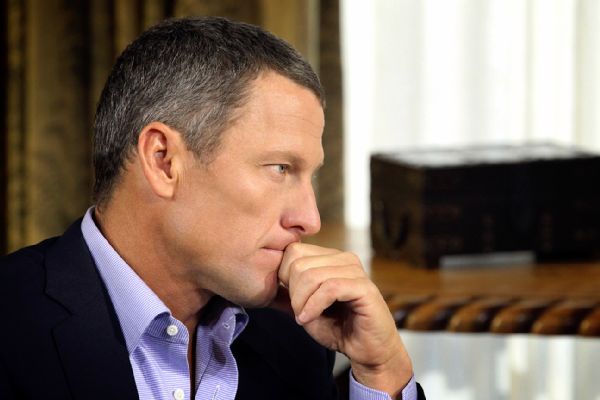
end_a_armstrong_d1_600x400     In a recent interview, Lance Armstrong has reiterated that he would cheat again if he had a chance to do it all over.  Lance Armstrong was revered as one of the greatest cyclists ever.  He won seven consecutive Tour de France titles from 1999 to 2005.  However, all the while Lance was winning those titles; he was also guilty of taking performance enhancing drugs (PEDs).

     Once it became known that Armstrong had been doping, his titles were stripped from him.  After years of denials that he was taking PEDs, he finally came clean in 2013 and admitted to the doping during his illustrious career.  He states in his recent interview that he would do it again to be competitive, because everyone was doing it.  His only regret is that he was put in a place where he had to make the decision to take PEDs, not that he actually gave in and doped to improve his performance.

     So, Lance would make the decision to run with the pack again.  Do you ever remember your mother asking you if you were going to jump off of the bridge just because everyone else was doing it?  Is that a legitimate excuse?  Lance Armstrong’s philosophy reeks of situational ethics.

     What do the words of Scripture have to say about situational ethics?  Is there ever a right time to do a wrong thing?  Paul writes, “Do not be deceived, God is not mocked; for whatever a man sows, that he will also reap.  For he who sows to his flesh will of the flesh reap corruption, but he who sows to the Spirit will of the Spirit reap everlasting life.  And let us not grow weary while doing good, for in due season we shall reap if we do not lose heart” (Galatians 6:7-9 NKJV).  Armstrong has allowed bad company to influence him to also do that which is wrong (1 Corinthians 15:33).  He has given in to running with the pack, rather than standing for what is right and good (competing according to the rules).  In his constant lying about his drug use, he has not let his yes be yes and his no, no (Matthew 5:37; James 5:12).

     Furthermore, James says, “Therefore, to him who knows to do good and does not do it, to him it is sin” (James 4:17).  Lance knew what he was doing was wrong.  He circumvented the rules to gain an advantage.  Many might say they understand.  Who wants to work in a bicycle shop in Plano, Texas when they can be on top of the world?  The problem is that if we do that which is wrong, and say that we would do the same thing again, we show no repentance for our sins.  It does not matter if everyone else is doing it.  Jesus said there was a broad and easy road, that many were traveling, and that this road leads to destruction (Matthew 7:13-14).

     God wants us to follow Him, not the pack.  He wants for all men to come to repentance (2 Peter 3:9).  There is never a right time to do a wrong thing.  Ethics are not situational.  Truth is absolute.  Cheating and lying are always wrong.  Will we be like Lance, and do whatever it takes to achieve fame and fortune in this life, only to lose our own souls (Matthew 16:26)?  Or will we be like Jesus and keep our focus on doing right so we can join Him for eternity, even if we have to struggle in a bicycle shop in the meantime?  Who will you follow?