Remember Me

 remember me     In William Shakespeare’s Hamlet, the title character has suspicions about his uncle regarding his father’s death. Those suspicions are confirmed when Hamlet speaks with his father’s ghost. The ghost admonishes Hamlet to action in his final words to his son by saying, “Remember me.”

     Although not in the form of a ghost, Jesus asks us to remember Him in one of His last acts before going to the cross. As He was gathered in that upper room with His twelve apostles, Jesus instituted the Lord’s Supper. He took from the unleavened bread and the fruit of the vine and He instructed them to eat and drink (Matthew 26:26-28). In so doing, they were to remember His sacrifice for their sins and the sins of all mankind. Jesus told them to “do this in remembrance of me” (Luke 22:19b NKJV).

     Later in his writing to the church in Corinth, Paul would repeat this admonition to remember the Lord by partaking in the Lord’s Supper. “For as often as you eat this bread and drink this cup, you proclaim the Lord’s death till He comes” (1 Corinthians 11:26). We also see in Scripture that it was upon the first day of the week, Sunday, that this memorial of the Lord was observed (Acts 20:7).

     There are many things that we may remember and make remembrances regarding them. It may be a special day in history. It may be a group of people who gave their lives in the defense of freedom. It may be in remembering some great leader or president. However, there is no one more deserving of our remembrances than the One who died to give us life. Let us be sure to remember Him each and every Lord’s Day especially. If you would like to know more about the One who died for your sins, come and see what God’s word has to say about Him.

He Kept His Integrity

Tom_Brady_2011     There is much ado in the news lately regarding the issue of integrity.  For fans of the NFL this is especially true as the defending Super Bowl champions were just punished for a lack of integrity regarding the rules for proper inflation of the game balls used in one of their playoff games last season.  At stake is the integrity of the game.  At stake is whether it is desirable to endure future punishment for a reward now.  However, what is really at stake is something that is so much more important than just that.

     We have been told that cheaters never win.  That lies will eventually unravel and the truth will be known.  Today, some seem to think that our integrity and reputations are not that important.  If an advantage can be gained so we can win today, then we will deal with the consequences later with the prize in our hands.  That philosophy, unfortunately for them, is severely short sighted.

     There is value in having a good name.  Solomon wrote in Proverbs, “A good name is to be chosen rather than great riches, Loving favor rather than silver and gold” (Proverbs 22:1 NKJV).  Silver and gold will perish.  Prizes and trophies will all gather dust or turn to rust.  There will be a time, however, when the quality of our name and the integrity of our lives will come into play.  There will be a time when we will be judged by something much more important than public opinion.  There will be a Day of Reckoning when all that we have done, whether good or bad will be brought into judgment by the God of the universe (2 Corinthians 5:10; Ecclesiastes 12:13-14).

     Just consider Job for a moment.  Job was a man who had great riches (Job 1:1-3).  He was a man who lost all that he had, including his children and his own health.  Even his own wife tormented him. “Then his wife said to him, ‘Do you still hold fast to your integrity? Curse God and die!’” (Job 2:9).  Job kept his integrity.  He did not stop doing what was right for some temporary relief.  He held fast to what was right.  Job said he would hold on to his integrity even to the point of death (Job 27:5).  That is who Job was.

     Who are we?  Will we hold fast to our integrity and do what is right even if it means we do not receive some temporary prize?  Or will we trade away our future, trade away our good name, for something that will one day perish in the dust?  Rest assured, what we do will find us out, either one way or the other. “He who walks with integrity walks securely, But he who perverts his ways will become known” (Proverbs 10:9). “The integrity of the upright will guide them, But the perversity of the unfaithful will destroy them” (Proverbs 11:3).  “Better is the poor who walks in his integrity than one perverse in his ways, though he be rich” (Proverbs 28:6).  Let us never trade our integrity for that which we think makes us rich.  Let us hold fast to the prize that is to come, which no one can take away from us!

I Know Whom I Have Believed

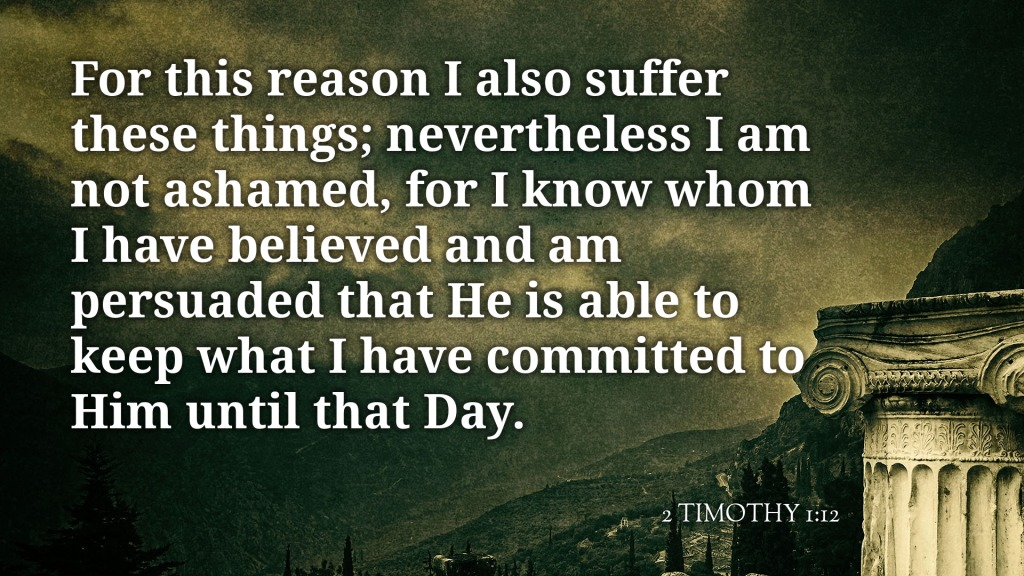
I Know WhomAs Paul is giving his final instructions to the young evangelist, Timothy, he writes, “For this reason I also suffer these things; nevertheless I am not ashamed, for I know whom I have believed and am persuaded that He is able to keep what I have committed to Him until that Day” (2 Tim. 1:12 NKJV). Let us notice a few things about this particular verse.

First, Paul says that he knows whom he has believed. Paul does not have any doubt about the God that he serves. From the time that Paul first saw the light on the road to Damascus and spoke to our Lord and Savior, he never turned away. Paul was steadfast in his faith, even with all of the trials he had to endure (2 Cor. 11:23-28). Paul knows God, and we can know God too. He has left us sufficient evidence (Rom. 1:20).

Second, Paul is convinced that God is able to do anything He desires. God is all powerful. He is the God who spoke all of creation into existence (Gen. 1). He is the God who parted the Red Sea for the Israelites to cross on dry ground (Ex. 14:21-22). He is the God who was gracious to Paul by giving him a second chance, when he was persecuting God in his pursuit of Christians (Acts 9:1-5). God wants to give us a second chance also. He is able to cleanse our sins in the precious blood of His Son. He is able to make us whole.

Third, Paul has committed something to God. Like Jesus on the cross, Paul has committed his spirit, his soul, his very existence into God’s hands. Paul trusts that God is able to keep his soul well guarded. Peter also spoke of God’s ability to keep our inheritance in heaven under guard (1 Pet. 1:3-5). For those who follow God, their inheritance is reserved. No thief will break in and steal it, and rust will not corrupt it. It is ours, if we will obey and remain faithful to God.

We, like Paul, can have confidence in God. We can believe. We can know that He is able. We can trust Him with our very souls. If you would like to know more about God, please come and see us at the South Stokes church of Chirst.

Honey Thieves Caught in Sting Operation

 honey-bees-326336_640    Recently in Pasco, Florida three men were hospitalized when their attempt to steal honey from a bee hive went horribly wrong.  Neighbors of the bee keeper reported hearing screams for help and seeing the three men rolling on the ground covered in bees.  Local firefighters were called out to rescue the men, who each received about fifty bee stings each for their folly.

     Whatever these men thought that they could gain in grabbing some free honey went by the wayside, as they found themselves stung instead.  Stories like these can often bring a wry smile to our faces, but let us consider what is at the heart of the matter.  The real issue is with trying to find easy gain that we have not worked for or earned.  This shows an attitude of discontent for what we already have been blessed with.

     The pages of scripture are rich in admonitions for us to be content with what we have.  Paul wrote, “I have learned in whatever state I am, to be content: I know how to be abased, and I know how to abound. Everywhere and in all things I have learned both to be full and to be hungry, both to abound and to suffer need” (Philippians 4:11b-12 NKJV).  Later, in writing to Timothy he would say, “Now godliness with contentment is great gain.  For we brought nothing into this world, and it is certain we can carry nothing out.  And having food and clothing, with these we shall be content” (1 Timothy 6:6-8).

     Paul would go on to instruct Timothy that those who desire to be rich fall into a destructive pattern and pierce themselves with many sorrows.  Those three men who were pierced by bee stings would certainly say that this is correct!  Jesus said that if we would first seek His kingdom and His righteousness, that we would have all of the needs of our daily lives taken care of by Him (Matthew 6:33).  Let us learn to be content with what we have, and to seek Him first and foremost in our lives!