Yaweh-jireh – The Lord will Provide

     There are eight various names or descriptions that are used to characterize God within the book of Genesis. One such name is Yaweh-jireh, which translated means God will provide. This name for God is found only once in Genesis 22:14.

     Abraham gives this name to God and to the location where he was to offer his only begotten son Isaac in Genesis 22. eightThis is significant in that it shows the attitude of Abraham that he had faith in God, and he believed that God would provide for him that which is necessary. The name Yaweh-jireh ties in with the thought expressed earlier in the chapter when Isaac inquires of his father about the lamb for the sacrifice (Genesis 22:8). Abraham’s answer to Isaac is “well-nigh prophetic” in answering him that they would be provided for by God Himself. This comes to fruition when Abraham is halted from his sacrifice of Isaac and a ram is provided by God for their sacrifice. Thus in the name Yaweh-jireh we find that the Lord has provided or seen to the needs of Abraham and Isaac.
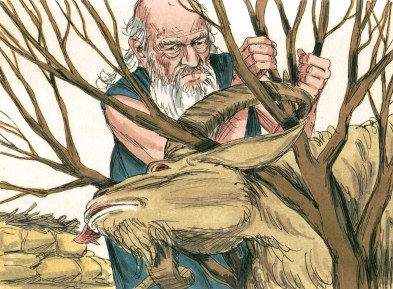
     Additionally, there are other implications that can be drawn from the use of the name Yaweh-jireh at this particular location geographically. Here Abraham is calling this place upon the mountain where he purposed to offer Isaac, the mountain where the Lord provides, and in this mount of the Lord it shall be seen or provided (Genesis 22:14). It is speculated that this may be the mountain that would later be the location of the Temple, where God would be worshipped, and where Jesus would later appear in person.   This may also be the mountain upon which Jesus would later be offered as a sacrifice, which has many parallels to the intended offering of Isaac. Adam Clarke, in his commentary on Genesis, says that it, “appears that the sacrifice offered by Abraham was understood to be a representative one, and . . . that Jehovah should be seen in a sacrificial way on this mount.” In this sense the Lord certainly did provide for man in this mountain. We all should be thankful for Jesus’ willingness to be that sacrifice for each of us!

Who Are You Listening To?

          After reigning over Israel for forty years, King Solomon died and rested with his fathers (1 Kings 11:42-43). The next in line to the throne was his son Rehoboam, but he had a test presented to him by the nation of Israel. How would he handle this challenge? Would he be able to win the hearts of the people? In order to face this great challenge, Rehoboam consulted with two groups of advisors before making his decision, which would shape the history of Israel for years to come.

            After calling the nation of Israel to Shechem, Rehoboam2191408271_3408b3e46c_o was presented with their challenge. They asked to have their burden reduced from what had been required by Solomon. Rehoboam asked for three days to consider their proposal. During that time he first consulted with the wise elders, who had advised his father. These men gave Rehoboam sound advice. They told him to lighten the burden on the people and they would serve him forever, but this was not what Rehoboam wanted to hear (1 Kings 12:1-8a).

            After hearing the advice of the wise elders, Rehoboam turned to the young men that made up his peer group. Their advice was to make the burden on the people heavier than what they had endured under Solomon. This was what Rehoboam wanted to hear, and perhaps this stroked his ego in that he could show that he was greater than his father. When the nation came back together to hear Rehoboam’s response, he told them that he would make his little finger thicker than his father’s loins (1 Kings 12:8b-11). This rude response did not set well with the Israelites.

            After hearing Rehoboam’s response, ten of the tribes of Israel went north with Jeroboam and formed the kingdom of Israel. Rehoboam lost out on the majority of the nation and the kingdom was divided, fulfilling the prophecy of the Lord as punishment for Solomon’s sins (1 Kings 12:15). Because Rehoboam heeded bad advice, his legacy was tarnished. He lost out on ruling over all the tribes of Israel except for Judah. The history of the Israelites was forever changed by Rehoboam’s decision to heed bad advice.

            After considering this lesson from the life of Rehoboam, what application can we make in our lives? When we have a major decision to make in our lives, to whom do we turn? Do we only want to have our ears scratched and hear what we want, or are we willing to hear the truth from wise men? We have the opportunity each day to heed the good words of God and to follow His statutes and His commandments. Or we can choose to listen to those around us, whose advice may sound good at the time, but the end of their path leads to ruin and misery. Whose advice will you heed this day?

Running Away From God

3633230337_6e4f9c4f0a_b     Imagine that you were told by your elders that you needed to travel to the Middle East and preach the gospel to members of a terrorist group that was responsible for terrible attacks upon your people. Would you be willing to go? Would you be eager to make that trip?

     In the days of Jeroboam II, king of Israel, God spoke to His prophet Jonah and instructed him that he was to travel to the great city of Nineveh (Jonah 1:1-2). Nineveh was one of three main cities in the Assyrian empire, and they were great enemies of Israel at the time. Additionally, they were Gentiles, and the Jews felt some exclusivity with regards to being God’s chosen people. Thus there was no love for the Assyrians within Israel, but animosity.

     We know that instead of traveling towards Nineveh that Jonah instead ran the other way, boarding a ship headed for Tarshish at the end of the known world at the time (Jonah 1:3). Jonah tried to run and hide from God, but God knew exactly where Jonah was, being that He is the creator of the land and the sea (Jonah 1:9). Jonah was not interested in the salvation of the Assyrians. After three days in the belly of a great fish, Jonah reluctantly went to Nineveh to preach repentance to the people.

     How is our attitude when it comes to preaching the gospel to others? Are we being selective in who we approach, because they are not like us? We should not allow our prejudice or bias keep us from sharing the truth of God’s word with anyone. God wishes for all men to come to the knowledge of the truth, to repent, and to be saved (1 Timothy 2:4). It is not up to us to limit the power of God. We are to be but simple messengers, carrying the story of the cross to this lost and dying world.