
If we were to take a survey and ask folks their answer to the question above, we would likely get many different responses. Some would claim that the terrorism that we see in our world today is mankind’s greatest problem. Others might say something related to the economy, the jobless rate, global warming, a want of political leadership, or the lack of unity among us as Americans that threatens to destroy us from within. Above and beyond all of these particular problems, though, is one problem that plagues all of mankind no matter where we live on the globe. That is the problem of sin.
While all of those worldly problems may threaten us while we are here, the problem of sin transcends this world and has implications in the life that is to come. The Bible says that all the things of this life are going to be destroyed someday. “But the day of the Lord will come as a thief in the night, in which the heavens will pass away with a great noise, and the elements will melt with fervent heat; both the earth and the works that are in it will be burned up” (2 Peter 3:10, NKJV). Sin has eternal results. Sin separates us from God. “Behold, the Lord’s hand is not shortened, That it cannot save; Nor His ear heavy, That it cannot hear. But your iniquities have separated you from your God; And your sins have hidden His face from you, So that He will not hear” (Isaiah 59:1-2).
Before you say that you have no sin in your life, consider what the Bible says about that as well. God’s word says that all have sinned (Romans 3:23). If we claim to not have sinned, we lie and the truth is not in us, and we are calling God a liar (1 John 1:8-10). Because of the sin problem that all men have, we need to have Jesus so that we can overcome it. We have to believe in Him and His power to cleanse us from sin if we will walk in the light (1 John 1:7). Jesus said, “Therefore I said to you that you will die in your sins; for if you do not believe that I am He, you will die in your sins” (John 8:24). Don’t die lost in your sins. Come to Jesus for His healing power and receive the gift of life instead!
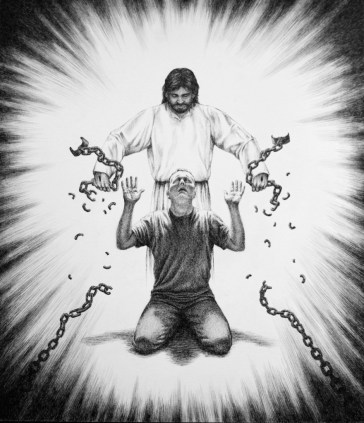 Have you ever wondered just why Jesus came to earth, especially at this time of the year when the world is thinking about Him? Consider for a moment what Jesus already knew before He ever left heaven. He knew that men would seek to kill Him as a toddler (Mat. 2:16). He knew that He would not be received by His own people (John 1:10-11). He knew that He would be rejected by men (Isaiah 53:3-5). He knew that He would be put to death on the cross, not for any wrong that He had done, but for the sins of mankind (Isaiah 53:9; 2 Pet. 2:22-25). And, yet, He came anyway. Why?
 In Charles Dickens’ novel, A Tale of Two Cities, there comes a point where one of the main characters, Charles Darnay, is arrested by the mob during the French Revolution and is sentenced to death. Because of the love that he has for Charles’ wife, Lucie, another character, Sydney Carton, takes Darnay’s place at the guillotine instead. As Carton goes to his death, he utters the most famous line of the novel, “It is a far, far better thing that I do, than I have ever done; it is a far, far better rest that I go to than I have ever known.”
 Modern science and evolutionary theory would have us believe that mankind is nothing more than another type of animal. The necessary conclusion of a “Big Bang” and an evolution of the species is that man is not special, we are nothing more than a happy accident, and thus man does not have an eternal soul. When those of us who have a different worldview consider this issue, we believe in the pages of scripture, which tell us that God made man in His image, that mankind is special and is above the animal kingdom, and that we have an eternal soul (Genesis 1:26-27). However, we often think of the soul as just another physical part of the body, like our heart or our mind.
 In the twelfth year of the reign of King Ahasuerus of Persia, Haman, the king’s right hand man, issued a decree that in eleven months all of the Jews within the Persian Empire were to be executed. Haman was looking to wipe out the Jews because Mordecai, a Jew living in the Persian capital of Shushan, refused to bow down to him. The decree was sealed with the king’s signet ring, which he had given to Haman. This meant that the decree carried the authority of the king, and under Persian law it could not be rescinded (Esther 3:7-12).
 salvation's path