Who Do You Trust?

3254678299_5c69afdc60_o    According to horoscope.com for a certain day, my outlook says, “A close friend or your partner could propose an impromptu trip and you might decide to go. You’re restless for adventure. . .” Many people may read that and become excited and think that they are going on a grand adventure! However, do the stars actually know anything about my destiny for today?

     The Bible tells us much about in whom and/or where we should place our trust, and the bodies of the cosmos are clearly not the answer. In the kingdom of Judah the kings who were good and pleased God placed their trust in Him. Manasseh was not one of these kings. Scripture tells us that Manasseh did evil in the sight of the Lord, much like the surrounding nations that the Lord removed from Palestine (2 Chron. 33:2). He built altars to other gods, he made idols, he worshiped the host of heaven (the moon, sun, starts, etc.), he practiced soothsaying and witchcraft, and he consulted with mediums and astrologers (2 Chron. 33:3, 5-6).

     Manasseh’s poor example led others astray in Israel, so that they did “more evil than the nations whom the Lord had destroyed before the children of Israel” (2 Chron. 33:9b). Because Manasseh trusted in everything imaginable besides God, and because Manasseh led the nation of Israel astray in so doing, God was going to punish the kingdom of Judah. Due to God’s wrath, they were going to have to suffer in Babylonian captivity for a period of 70 years. The transgressions that were committed under Manasseh made this a certainty, so that even when a good king like Josiah came along, the fate of Israel was sealed (Zeph. 1:2-6). God was going to wipe out “those who worship the host of heaven” from Israel (Zeph. 1:5a). Their trust in the stars was misplaced. They should have trusted in the Lord.

     Where and in whom are we placing our trust? Is it in our daily horoscope, to see what the stars have in store for us? Or do we place our trust in the Almighty God? Having our trust placed firmly in God is the only way that man can be pleasing to Him (Psalm 4:5; 9:10; 18:30; Prov. 3:5). There is no need for us to ‘hedge our bet’ by trying to trust God, but also consulting mediums, soothsayers, and astrologers. Trusting in the cosmos caused Israel much harm, caused God much grief, and caused God to be angry with them. We certainly don’t want God to be angry with us, regardless of what the stars may say.

What Is Sin?


     If you ever want to bring a conversation to a screeching halt, just talk to someone about the issue of sin! In our politically correct, nothing is ever wrong, who are you to judge me world, the topic of sin or of pointing out that something is morally wrong has been equated with hate speech. Thus we are left with an “if it feels good, do it” society that does not understand the difference between right and wrong.

arrows missing target

     Just what is sin? The first mention of sin in the Bible has to do with Cain’s undesirable sacrifice. God says, “If you do well, will you not be accepted? And if you do not do well, sin lies at the door. And its desire is for you, but you should rule over it” (Genesis 4:7, NKJV). The word ‘sin’ in this passage carries with it the idea of a crouching beast, waiting to pounce on its prey. In archery, the term ‘sin’ is used when the archer misses the mark and fails to hit the target. With regards to us, we sin when we miss the mark and do not live up to God’s desire for us. Sin is breaking the law of God. “Whoever commits sin also commits lawlessness, and sin is lawlessness” (1 John 3:4). These are sins of commission (something that we did). There are also sins of omission (failing to do what is right). “Therefore, to him who knows to do good and does not do it, to him it is sin” (James 4:17).

     How then do we judge between what is right and what is wrong/sinful? It is not according to our own wishes and desires, for we are mere men. Who are we to determine what is right or wrong and to be the judge of it? We need a higher standard than what man deems right or wrong. Solomon has said, “There is a way that seems right to a man, But its end is the way of death” (Proverbs 14:12). Jeremiah prophesied that it is not in man to direct his own steps (Jeremiah 10:23). Thus we need to turn to God’s word, and His Holy Standard in order to see what is right and what is wrong. Paul wrote that he would not have known what was sin had God’s law not revealed that to him (Romans 7:7).

   We have an obligation to check these things out in the Bible. Let us allow God’s word to give us our direction regarding what is right and wrong. Let us not lean upon man’s understanding and end up in sin. Sin leads to death (James 1:12-15; Romans 6:23). Obedience to God will lead us to life (Romans 6:16). Let us reject sin and live!

How Do You “Feel” About That?

2269421     I recently read a blog article by someone who claims to be a Christian about what it takes to be a Christian.  I am sure that there are many blogs out there that address this issue in one way or another, but what was interesting about this particular post is what the author claimed he believed.  Or, to be more accurate, what he claimed to not believe.  The author stated that he does not believe that Jesus is God.  He does not believe that Jesus walked on water, healed the sick, raised Lazarus from the grave, was born of a virgin, was raised Himself after three days in the grave, or that He died for the sins of mankind.  So we may ask the question, why does he consider himself to be a Christian?  Reading on in the article, the author’s beliefs were based purely on what he “feels” about God.

     If the basis of religious truth is nothing more than how we feel about something, how could you ever prove what is true?  I may feel that one thing is true and someone else may feel that the opposite is true, so which one is correct?  Truth has to be based on facts.  I may feel that the water is cold.  Someone else may feel that the water is hot.  But if we take a thermometer and measure the temperature of the water, now we have established the facts.  Now we can know if the water is really cold or hot.

     If we are going to follow Jesus.  If we are going to be one of His.  If we are going to call ourselves Christians (meaning that we belong to Christ).  Then we need to pay attention to what He said and what He did.  Jesus established the basis of truth in His prayer to the Father, “Sanctify them by Your truth. Your word is truth” (John 17:17, NKJV).  What are the facts in this case?  What is it that we are to believe?  Let us look into the truth of God’s word for that answer, for without God’s word we would have no facts at all about who God is, what He is like, or what He desires for us to do.

     Jesus said that He was God. “And He said to them, ‘You are from beneath; I am from above. You are of this world; I am not of this world.  Therefore I said to you that you will die in your sins; for if you do not believe that I am He, you will die in your sins’” (John 8:23-24).  In this particular passage Jesus says that unless you believe that “I am” you will die in your sins.  That “I am” statement should take us back to Moses and the burning bush, where God told Moses to tell the Israelites that I AM had sent him (Exodus 3:14).  If we are going to claim to be followers of Jesus, should we not believe what He said?

     Why claim to follow Jesus if He was not raised from the dead?  This does not make any logical sense.  If He was not raised from the dead then there is no basis for the Christian religion.  Without the resurrection of Christ, there is no foundation for Christianity.  Consider what the apostle Paul wrote by inspiration:

Now if Christ is preached that He has been raised from the dead, how do some among you say that there is no resurrection of the dead?  But if there is no resurrection of the dead, then Christ is not risen.  And if Christ is not risen, then our preaching is empty and your faith is also empty.  Yes, and we are found false witnesses of God, because we have testified of God that He raised up Christ, whom He did not raise up—if in fact the dead do not rise.  For if the dead do not rise, then Christ is not risen.  And if Christ is not risen, your faith is futile; you are still in your sins!  Then also those who have fallen asleep in Christ have perished.  If in this life only we have hope in Christ, we are of all men the most pitiable (1 Corinthians 15:12-19, emphasis added).

If Jesus was just another man, why follow Him rather than anyone else?

     The reason that Christians follow Jesus Christ is because He was not just a man.  Jesus is God (John 1:1-5, 14).  Jesus arose from the dead and was seen by many witnesses, which the people in that day and age were unable to discredit (1 Corinthians 15:3-8).  Because He rose from the grave, His apostles and disciples had a newfound courage to be able to go to martyrdom and not worry about losing their physical lives.  Now they understood that there was something more beyond the grave, and so they no longer turned away or deserted their Savior in times of trouble.  If Jesus had not been resurrected, this would not have been the case.

     If we are going to call ourselves Christians, it would seem logical to suppose that we are going to believe what Jesus said, and that we are going to do what Jesus said to do.  We can claim all day long to be one of His, but if we are not doing what He said, then that claim is false.  I can claim to be the King of Morocco, but claiming it does not make it so.  What is the truth of the matter?  Jesus said,

Not everyone who says to Me, ‘Lord, Lord,’ shall enter the kingdom of heaven, but he who does the will of My Father in heaven.  Many will say to Me in that day, ‘Lord, Lord, have we not prophesied in Your name, cast out demons in Your name, and done many wonders in Your name?’  And then I will declare to them, ‘I never knew you; depart from Me, you who practice lawlessness!’ (Matthew 7:21-23).

We had better know what the will of the Lord is, which is based upon the truth of His word and not upon our feelings.  “And do not be conformed to this world, but be transformed by the renewing of your mind, that you may prove what is that good and acceptable and perfect will of God” (Romans 12:2).  You cannot prove it, if you do not know it!  However, we can know for sure what the Lord requires of us.  Paul wrote in Ephesians, how that by revelation He made known to me the mystery (as I have briefly written already, by which, when you read, you may understand my knowledge in the mystery of Christ)” (Ephesians 3:3-4).  When we read God’s word, we can understand what He requires.  We can know what His will is.  Come and see what God’s word has to say on this subject and many others.  The Holy Bible can help us to cut through the fog of confusion and see the truth for what it really is!

Jesus Is Better

Jesus Footprints     In a good news article the four ‘W’s are usually brought out in the first paragraph.  At least that’s what I remember from my very brief education on journalism from a long ago English course.  Writers want to let the reader know who, did what, when, and where.  In looking at the beginning of the book of Hebrews, we might call the writer a good journalist. “God, who at various times and in various ways spoke in time past to the fathers by the prophets, has in these last days spoken to us by His Son, whom He has appointed heir of all things, through whom also He made the worlds” (Hebrews 1:1-2, NKJV).

     Notice with me some of what is in these two little verses of scripture.  First, in verse one, God is the who.  Spoke is what He did.  The when is in times past, and the where was to the fathers.  The verse also tells us how God did that.  It was at various times and in various ways and through the mouth of the prophets that God spoke to mankind in times past.  Second, in verse two, God is still the one speaking, so the who and the what are the same.  However, now that speaking has been done in these last days, and it has been spoken to us by His Son, Jesus Christ.

     There are many lessons that we can learn from the old law and the Old Testament (Romans 15:4).  However, now we are told to hear God’s Son and pay the more earnest heed to His words (Matthew 17:5; Hebrews 2:1-4).  Indeed the message that comes from the entire book of Hebrews is that Christ is better.  He is better than the angels.  He is better than Moses.  He is better than the human high priests.  He mediates a better covenant, established on better promises, with a better hope (Hebrews 7:19; 8:6).

     It is Jesus Christ, the one and only unique Son of God, who has brought salvation to mankind.  We need to hear what He has to say.  We need to obey His commands.  Otherwise, how shall we escape the punishment for our sins that we deserve? “How shall we escape if we neglect so great a salvation, which at the first began to be spoken by the Lord, and was confirmed to us by those who heard Him” (Hebrews 2:3).

Return to Me

1280px-Minnesota_soldier_returns_home     We often rejoice in seeing loved ones return to one another after time away.  Perhaps there was some conflict or estrangement that kept them apart.  Perhaps some grudge that had to be overcome for them to be together again.  Maybe it is the return home of those who have been involved in military duty overseas.  Whatever the reason, there is joy in witnessing their reunion again after being apart.

     We should have the same joy in seeing those who have been estranged from the Lord being reunited to Him.  Often times those who have wandered away from God may feel that they cannot overcome their sinful desires, or that perhaps, God will not forgive them of their transgressions.  Neither of those are the case, however.  God through the writing of Paul makes it abundantly clear that they can be washed clean of their sins if they will repent and return (1 Cor. 6:9-11).

     Many times God was angry with Israel for not obeying His commands.  They refused to remove the inhabitants of Canaan and to destroy their idols, and instead served those foreign gods, offering their children as sacrifices (Psalm 106:34-39).  Therefore, they were given into the hands of their enemies and they were oppressed (Psalm 106:40-42).  Yet each time they cried out to the Lord for deliverance, each time they returned to the Lord, He heard the cries of His people and delivered them out of danger (Psalm 106:43-45).  God delivered them because He wants to be merciful.  If you have wandered away, God also wants to show you mercy and forgiveness.

     In order to get God’s mercy, we need to return to Him.  God promised Israel in times past, “but if you return to Me, and keep My commandments and do them, though some of you were cast out to the farthest part of the heavens, yet I will gather them from there, and bring them to the place which I have chosen as a dwelling for My name” (Nehemiah 1:9, NKJV).  God makes the same promise to us also.  He does not want any to perish, but for all to come to repentance (2 Peter 3:9).  Jesus said that when we return, there is much rejoicing.  “I say to you that likewise there will be more joy in heaven over one sinner who repents than over ninety-nine just persons who need no repentance” (Luke 15:7).

     God wants us to return to Him.  He wants us to be with Him for eternity.  He does not want any to be lost.  If you are willing to repent, He is faithful to forgive (1 John 1:9).  If you have wandered astray, won’t you return to Him now?

I Beg Your Pardon

     Richard Nixon is credited with once saying that if the President did it, it was not illegal.  However, after months of investigative journalism, congressional hearings, subpoenas, and contemplation of impeachment, he found out otherwise.  Nixon eventually resigned as President.  The only thing that kept him from suffering the same legal consequences as his cohorts, was a presidential pardon by his successor.

     This bit of history shows us that no one is above the law.  Without a pardon from above, we will all suffer the consequences of our actions.  We know that all have sin in their life.  The Bible says, “For all have sinned and fall short of the glory of God” (Romans 3:23 NKJV).  Furthermore, “The wages of sin is death” (Romans 6:23a).  Our natural state, without that pardon or forgiveness from above, is to be dead in our sins and in a lost condition.

     But thanks be to God that forgiveness is available!  We need to be willing to confess our sins rather than trying to cover them up (1 John 1:9).  We need to be willing to repent of those things that are contrary to God’s word (Luke 13:3; 2 Corinthians 7:10).  Having godly sorrow will lead us to a change of mind, a change of direction, which is what repentance is really about.  It is more than just being sorry that we were caught with our hand in the proverbial cookie jar.

     We need to seek out God’s pardon and forgiveness, because none of us is perfect.  We must throw ourselves on His mercy in order to have that eternal life we so desire.  We must be willing to change our lifestyle, to do our best to go our way and sin no more.  God offers us a pardon from our sins.  Are you willing to do your part to receive that forgiveness?

The Truth is Black and White

Picture1     Rachel Dolezal is not black.  She was born to two white parents, but later bronzed her skin and changed her hairstyle.  After claiming to be black, she was made a local leader in the NAACP.  Recently, her parents have spoken out to say that Rachel is not black.  Rachel responded by saying, “Nothing about being white describes who I am. So, you know, what’s the word for it? The closest thing that I can come to is if you’re black or white, I’m black. . . I’m more black than white. On a level of values, lived experience currently. In this moment, that’s the answer. That’s the accurate answer from my truth” (http://www.msn.com/en-us/news/other/rachel-dolezal-says-theres-no-biological-proof-of-who-her-parents-are/ar-AAbI12V?ocid=ansnewsap11).

     Notice that she says “in this moment” she is black, as if we are able to change our heritage over the course of time.  I can get a suntan, grow dreadlocks, and start to speak with an accent (Hey, mon, don’t ya know it), but that will not make me Jamaican.  The truth is not something that is subject to change over time.  Jesus prayed that God would sanctify or set His people apart by the truth, which is God’s word (John 17:17).  The Bible tells us that “Jesus Christ is the same yesterday, today, and forever” (Hebrews 13:8 NKJV).  We are not to add to or take from God’s word (Deuteronomy 4:2; 12:32).  Jesus said His words would endure forever (Matthew 24:35; Mark 13:31).

     Rachel believes that her answers are according to “her truth,” but truth is not relative.  I cannot have one truth that is different from your truth.  I can have an opinion that is different than yours, but there is only one truth.  If I were to say that the lights are on and you were to say that the lights are off, both of those statements cannot be true at the same time.  The truth does not depend on our environment or our situation in life.  Water is wet.  Jesus is Lord.  There is just one God.  These things are true whether we believe and accept them or not.  The truth is not gray.  The truth is black and white.

     “Your righteousness is an everlasting righteousness, And Your law is truth” (Psalm 119:142). “You are near, O Lord, And all Your commandments are truth” (Psalm 119:151). “The entirety of Your word is truth, And every one of Your righteous judgments endures forever” (Psalm 119:160).  God’s word could not be clearer on this subject.  Yet, there are those who will still ask the question that was on Pilate’s lips as Jesus stood before him, “What is truth?” (John 18:38).  If you want to know more about the truth, read God’s word.  If you want to find eternal life, you must believe it to be true (Romans 10:17; Hebrews 11:6).  If we can help you on your journey, come and see what the Lord has done for us!

The Impossible Dream?

Fergusonhug-v2     Unity.  Too often today we look for unity, only to find division and strife.  Whether in regards to race relations, politics, sports, or our outlook on life, we as a people seem to have gravitated towards focusing on what divides us rather than what unites us.  But how do we achieve unity?  Is it achievable?  How do we begin?

     First we need to realize that unity is only achievable if we are all using the same standard to measure our beliefs and behaviors.  That standard is the Word of God.  If we would all go to the Bible for the foundation of our beliefs, our behavior, our religious practices, and what we say and do, then we would have unity.  Not possible, you say?  Well, just look at Jesus’ own Apostles.  One of them was Simon, a zealot (Luke 6:15).  The zealots were known for political assassinations of Romans and for stirring the people up in revolt.  Another of the Apostles was Matthew, who was a tax collector for the Romans (Matthew 10:3).  Yet, the two of them worked together in unity as Apostles, because they were united in Christ, the Word of God (John 1:1-2, 14).

     If we were to use the Bible as our guide, not our own understanding or our own thoughts and ideas, then we could fulfill Jesus’ prayer in the garden.  Jesus said, “I do not pray for these alone, but also for those who will believe in Me through their word; that they all may be one, as You, Father, are in Me, and I in You; that they also may be one in Us, that the world may believe that You sent Me” (John 17:20-21 NKJV).  Jesus wanted His followers to be one, to all be on the same page, to be united, so that the world would believe.  Many point to divisions between religious groups as proof that there is no God.  They are right about the divisions, but not about atheism.

     The Scriptures often speak of unity.  We are to be of the same mind (Rom. 12:16; 1 Cor. 1:10; Phil. 2:2; 3:16; 4:2; 1 Peter 4:1).  We are to speak the same things (1 Cor. 1:10; 2 Cor. 4:13).  We are to have the same foundation (1 Cor. 3:10-11; Eph. 2:19-20).  Paul wrote, “I, therefore, the prisoner of the Lord, beseech you to walk worthy of the calling with which you were called, with all lowliness and gentleness, with longsuffering, bearing with one another in love, endeavoring to keep the unity of the Spirit in the bond of peace” (Eph. 4:1-3 emphasis added).

     We are to have unity, but not a unity where we water down God’s word to the point that it is no longer recognizable.  We can preach tolerance for others and diversity to the point where we accept two mutually opposite points as both being true.  How can that be?  No, if we are to have unity, then that unity must be based upon the same standard.  It must be based upon the truth of God’s Word.  We do not achieve unity by capitulating on the truth or by trying to make truth relative.

     You may not believe that we can have unity.  However, in looking at how much the Bible speaks of unity ask yourself one question.  Would God ask us to do something that is not possible?  God as told us to be unified.  He has given us His standard to guide us in that unity.  His Son prayed for that unity.  Why do that if it is not achievable?  If we would just go to His Word, study what it really says, and then do that, we could have unity.  We could be one in Christ like as the Apostles.  That would be a better way!

God’s Path to Salvation – Step Five – Be Baptized

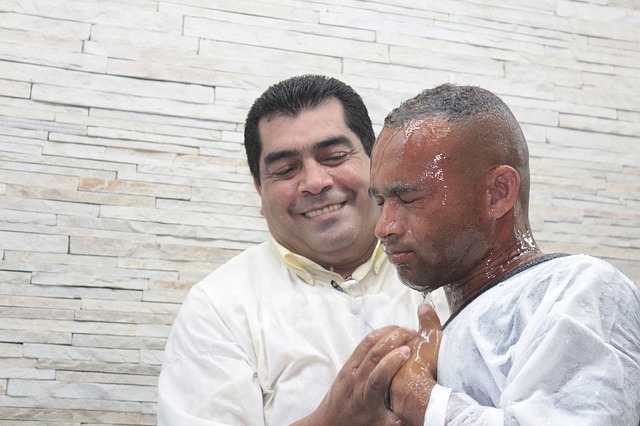
baptism     After hearing and believing the Word, if we are willing to submit to God by confessing our allegiance to Christ and repent of the things we are doing that are wrong, we can become a child of God by being baptized for the remission of our sins.  This step in God’s path to salvation seems to be the most misunderstood and most debated of all of what God requires of us.  Yet, it is a simple step, which the pages of scripture call us to do.  Jesus commands baptism.  The apostles commanded baptism.  Paul was instructed to be baptized.  All of those who converted to Christianity that we can read about in the book of Acts were baptized as part of their conversion.  If you do not believe me, see what God’s Word says about the subject!

     As Jesus was bidding His disciples farewell just before ascending into heaven, He gave them His final instructions.  “And He said to them, ‘Go into all the world and preach the gospel to every creature.  He who believes and is baptized will be saved; but he who does not believe will be condemned’” (Mark 16:15-16NKJV).  Notice here that Jesus states that the one who is a believer and has been baptized will be saved.  It is the same as saying, he who has a ticket and gets into line will be admitted to the game.  We have to have the ticket first in order to get into the game.  If we do not have a ticket, there is no sense in getting into line.  Thus, we have to believe before we are baptized.  If we do not believe, then baptism alone will not affect us.  Additionally, it does us absolutely no good to have a ticket for the game, but to never get into line to enter the building.  Just buying our ticket does not grant us admittance.  Likewise, in order to be saved one must believe and be baptized.

     In Matthew’s recording of the great commission, he writes that Jesus told them to make disciples from all of the nations (Matthew 28:19).  How is it that they were to make disciples?  Jesus tells them how.  He said that they were to baptize them in the name of the Father, Son, and Holy Spirit, and to teach them to observe all of Christ’s commandments (Matthew 28:19-20).  That is how disciples are made.  If you have not been baptized, you are not a disciple (follower) of Jesus Christ.

     It is the act of baptism that washes away our sins.  God did His part in sending His one and only unique Son to die on our behalf, so that our sins might be covered.  Jesus died so that we could be cleansed, sanctified, made holy, and set apart (Romans 5:6-11).  But we also have to do our part in accepting that grace of God.  It is not enough for us to receive a great prize notification, and say that we are rich.  We must claim that prize in order for it to have the intended effect.  It is the act of baptism that puts us in contact with the blood of Christ.  The water has no magical properties, but the act of obedience to what the Lord commanded means that His blood cleanses us from sin.  Paul wrote to the church in Rome, “. . . do you not know that as many of us as were baptized into Christ Jesus were baptized into His death?  Therefore we were buried with Him through baptism into death, that just as Christ was raised from the dead by the glory of the Father, even so we also should walk in newness of life” (Romans 6:3-4).  Being buried with Him in the likeness of His death signifies how we come in contact with the blood He shed, so that our sins can be covered.  Being compared to a burial also tells us of the method of baptism.  It is an immersion, a complete covering.  Otherwise, it is not a burial.

     Peter said that baptism was the act that removes our sins when he preached to the crowd on the day of Pentecost.  On that day the doors of the church were opened for the first time.  Peter explained that those Jews in Jerusalem had been responsible for rejecting Christ and having Him crucified.  They were responsible for His death.  Imagine how they must have felt when Peter showed them that they had put the one and only Son of God to death!  This news pricked them in their hearts.  They were convicted by the word.  They were convinced that they had done wrong.  They wanted to know what they could do to get out of such a terrible predicament (Acts 2:22-37).  “Then Peter said to them, ‘Repent, and let every one of you be baptized in the name of Jesus Christ for the remission of sins; and you shall receive the gift of the Holy Spirit’” (Acts 2:38).  Notice what Peter did not tell them to do.  He did not say to just accept Jesus in your heart and all would be well.  He did not say to repeat a “sinners prayer,” which is not found in Scripture, in order to be saved.  He told them to repent and be baptized.  One is no good without the other.  They were to be baptized for the remission of sins.  Since baptism is the way to remit our sins, if we are not baptized our sins are not remitted.  Later Peter would write that baptism now saves us (1 Peter 3:21).

     One last example to consider is the conversion of Paul.  Paul was a persecutor of the church.  He did not believe in Jesus.  As he was on the way to Damascus to round up more Christians for trial and execution, he saw a bright light and heard the voice of Christ.  Surely that would be enough to save Paul, right?  Notice what Paul was told to do by Jesus.  “Arise and go into the city, and you will be told what you must do” (Acts 9:6b).  So Paul went into Damascus.  There he was told what he must do in order to be saved.  When Ananias came to him, Paul had been praying and fasting for three days (Acts 9:9).  Ananias said to Paul, “And now why are you waiting? Arise and be baptized, and wash away your sins, calling on the name of the Lord” (Acts 22:16).

     Notice that Paul was not saved by seeing Jesus.  He was not saved by speaking to Jesus.  He was not saved by praying and fasting for three days.  If he had been, then why would Ananias have to tell him to be baptized to wash away his sins?  If he had already been saved prior to baptism, there would be no sins that still needed to be washed away.  Notice also that Ananias tells Paul how to call upon the name of the Lord.  You may recall from step one of God’s path to salvation that in Paul’s writing to the Romans in chapter 10 of that letter, Paul told them that those who are saved are those who call upon the name of the Lord.  How do we call upon the name of the Lord?  We do so by obeying Him.  Ananias told Paul that baptism is how we wash away our sins, and how we call upon the name of the Lord.

     The Bible tells us that all of our spiritual blessings are to be found in Christ Jesus (Ephesians 1:3).  Those who are in Christ are no longer condemned (Romans 8:1).  Those who are in Christ are new creatures, having been born again (2 Corinthians 5:17).  Salvation is only to be found in Christ (2 Timothy 2:10).  In Christ, we can have eternal life (1 John 5:11).  So how do we get in Christ in order to receive all of these blessings?  We get in Christ by being baptized into Christ.  “For you are all sons of God through faith in Christ Jesus.  For as many of you as were baptized into Christ have put on Christ” (Galatians 3:26-27, emphasis added).  We must be in Christ to receive the blessings.  We get in Christ by obeying what He has told us to do.  For that, He commanded us to be baptized.

God’s Path to Salvation – Step Four – Repent

14130441997_a4c5a31a2d_o     The next step in God’s path to salvation is to repent of the things that we have done, or are doing, which are not in accordance with God’s word.  Jesus Himself taught that repentance was necessary when He taught His disciples about those Galileans who were killed by Pilate, or about those upon whom the tower of Siloam had fallen upon.  He told them that unless they repented they would all likewise perish (Luke 13:3, 5).

     Similarly, Paul stood upon Mars’ Hill in Athens and preached to those who were listening about the “unknown” God.  In that address, Paul stated that repentance was necessary for salvation.  Regarding their past ignorance of God’s will he told them, “Truly, these times of ignorance God overlooked, but now commands all men everywhere to repent, because He has appointed a day on which He will judge the world in righteousness by the Man whom He has ordained. He has given assurance of this to all by raising Him from the dead” (Acts 17:30-31).  Notice that God calls upon all men, all of mankind to repent.  Notice also that He calls upon all men everywhere.  That means that no one is exempt from the command to repent.

     Later, Paul would tell young Timothy that God wants all men to come to a knowledge of the truth and to be saved (1 Timothy 2:4)  Additionally, Peter explains that God is not willing for anyone to perish spiritually.  He wishes for all men, again that is all of mankind, to repent of what they have done wrong.  Peter writes, “The Lord is not slack concerning His promise, as some count slackness, but is longsuffering toward us, not willing that any should perish but that all should come to repentance” (2 Peter 3:9).  Because it has been almost 2,000 years since the sacrificial death of Jesus upon the cross, men are likely to wonder about the second coming.  It is God who is holding off on the end of the world, because He does not want anyone to perish.  He wants all men everywhere to come to repentance and be obedient to His will.

     Therefore, we need to repent of our sins in order to lay hold of eternal life, but just what is involved in that repentance?  Is it just saying that I am sorry for what I have done?  Is it just saying that I am sorry that I got caught doing something wrong, or is there more to it than that?  We must not be misled into thinking that repentance is just a feeling of momentary sorrow with no change in our actions.  There is much more to repentance than just that feeling of sorrow.  Repentance means that we make a change in our life.  We do not just feel sorry for what we have done, but if we are sinning against God then we change our lifestyle to reflect His wishes, His commands, His will.  Paul explains this difference in writing to the church at Corinth:

Now I rejoice, not that you were made sorry, but that your sorrow led to repentance. For you were made sorry in a godly manner, that you might suffer loss from us in nothing.  For godly sorrow produces repentance leading to salvation, not to be regretted; but the sorrow of the world produces death.  For observe this very thing, that you sorrowed in a godly manner: What diligence it produced in you, what clearing of yourselves, what indignation, what fear, what vehement desire, what zeal, what vindication! In all things you proved yourselves to be clear in this matter (2 Corinthians 7:9-11)

Notice that Paul is not rejoicing in their sorrow, but in the fact that their godly sorrow produced repentance, a change of direction.

     It is our godly sorrow that will lead us to repentance.  Our repentance, our change of mind, our change of direction will then lead us to God and His salvation.  It is not like the sorrow of the world whereby we might just be sorry that we were caught in wrongdoing.  Let us all put our sins behind us, and throw off that weight so that we may run our race unencumbered by sin (Hebrews 12:1).  Let us learn to repent of what we do that does not match God’s will, so that we can have that hope of eternal salvation when our life here is done!