 Start discussing the biblical requirement to be baptized with someone and see how long it takes before they mention the thief on the cross. Odds are it will not take too long. That is because there is a widespread doctrine in the religious world that tries to eliminate the need for baptism by appealing to the example of this particular individual, whom Jesus told would be with Him in paradise on the day they both died (Luke 22:43). Just what does this example tell us about salvation? Does the example of the thief on the cross really mean that one does not need to be baptized in order to be saved? Let us look at this issue by noticing three things about this man being forgiven by Christ.
First, the argument is made that the thief was never baptized, and yet Jesus tells him that they will be together in paradise. Is it the case that he was never baptized? How would you prove that? The thief obviously knew something about Jesus and His ministry, for he confesses, “‘. . . we receive the due reward of our deeds; but this Man has done nothing wrong.’ Then he said to Jesus, ‘Lord, remember me when You come into Your kingdom’” (Luke 22:41b-42, NKJV). He knew that Jesus had done nothing wrong, and he had faith in that even though Jesus was hanging on the cross, death would not keep Jesus from receiving His kingdom. How did he know that? Was he a disciple of Christ, perhaps? Had he been baptized by John in the Jordan? It was said of John that, “Then Jerusalem, all Judea, and all the region around the Jordan went out to him and were baptized by him in the Jordan, confessing their sins” (Matthew 3:5-6). Was the thief on the cross in this crowd that John was baptizing? It cannot be proven from scripture that the thief was baptized, but it equally cannot be proven by scripture that he was not.
Second, it should be noted that Jesus had the power to forgive sins while he was on this earth. If Jesus wanted to forgive the thief on the cross based upon his confession of faith, He had the ability to do so. Just look at the example of the paralytic, whom Jesus healed in Mark 2. Unable to reach Jesus in the house because of the crowd that had gathered, the friends of the paralytic man lowered him through the roof so that he could get to Jesus. “When Jesus saw their faith, He said to the paralytic, ‘Son, your sins are forgiven you’” (Mark 2:5). The scribes accused Jesus of blasphemy, since only God could forgive sins. To show that He had the power and authority on earth to forgive sins, Jesus healed the man of his paralysis (Mark 2:6-12). Notice that the text says nothing about whether this man was baptized or not either!
This brings us to the third thing that we want to take notice of regarding both the thief on the cross and any others, whom Jesus forgave while on the earth. While Jesus lived on the earth, the Mosaic Law was in effect. The New Covenant had not yet been offered to anyone. There was a new covenant that was coming, but it did not go into effect until the death of Christ. Jeremiah prophesied about this new covenant between man and God.
Behold, the days are coming, says the Lord, when I will make a new covenant with the house of Israel and with the house of Judah— not according to the covenant that I made with their fathers in the day that I took them by the hand to lead them out of the land of Egypt, My covenant which they broke, though I was a husband to them, says the Lord. But this is the covenant that I will make with the house of Israel after those days, says the Lord: I will put My law in their minds, and write it on their hearts; and I will be their God, and they shall be My people. No more shall every man teach his neighbor, and every man his brother, saying, ‘Know the Lord,’ for they all shall know Me, from the least of them to the greatest of them, says the Lord. For I will forgive their iniquity, and their sin I will remember no more (Jeremiah 31:31-34).
This new covenant is the last will and testament of Jesus Christ. As with our own wills, no will or testament is enforced while the one who willed it is alive. A will is only in force after the death of the testator. That is exactly what is said about the new covenant in the Holy Scriptures (Hebrews 9:16-17). Just as the covenant, or agreement, between God and man that was offered at Mount Sinai was sealed in blood, so too would the new covenant between man and God be sealed with the blood of Christ (Hebrews 9:18-22; Luke 22:20).
The new covenant was first offered to mankind on the day of Pentecost, as is recorded for us in Acts 2. If we will obey God and do what He commands, then we can have our sins remitted and have the hope of eternal life with Him. That is the agreement. Notice what Peter says they are to do when asked about how they can be saved. “Then Peter said to them, ‘Repent, and let every one of you be baptized in the name of Jesus Christ for the remission of sins; and you shall receive the gift of the Holy Spirit’” (Acts 2:38). Since the thief on the cross lived and died during the old covenant, and since the new covenant was not offered to anyone until the day of Pentecost, the thief on the cross was not subject to the requirements of the new covenant. But guess who is subject to the new covenant. That’s right! We are!
God’s word could not be clearer on the need for baptism for the remission of our sins in order for us to have salvation. Jesus said, “He who believes and is baptized will be saved; but he who does not believe will be condemned” (Mark 16:16). If He didn’t mean it when He said it, then how would He have said it if He meant it? Jesus said exactly what He meant. He who believes AND is baptized will be saved. For more on God’s Path to Salvation, please click on this link. The fact that the thief on the cross received forgiveness and went to paradise that day does nothing to save our souls. We must be obedient to the One who died for us. We must live according to His will and testament. We are no longer under the Mosaic Law. Don’t take my word for it. See what the scriptures have to say about our belief, obedience, and salvation!
 Recent research has suggested that the consumption of grape juice is an aid in either avoiding Alzheimer’s, or that it can slow the process of memory loss in those with the brain disease. Alzheimer’s is thought to be brought on by stress and free radicals in a person’s physiology. Since antioxidants combat free radicals, and since grape juice is rich in antioxidants, the thought is that grape juice can help combat one of the causes of the disease (http://www.ncbi.nlm.nih.gov/pmc/articles/PMC3544087).
 Have you ever prayed for God to take care of some problem that you had, and then wondered what the answer to that prayer would be? It is especially difficult for us as Americans to be patient in waiting for a response. We are so accustomed to fast food, microwave ovens, and instant messaging that we expect immediate results. Additionally, it may be that the answer to our prayer is “not now,” and so we have to wait awhile for the result. This is a normal situation, but during the time of Hezekiah, he received an instant response to one of his prayers.
 There is an old Stevie Wonder song where he sings about someone being the apple of his eye. The descriptive “apple of his eye” is used to denote that person who is most precious to him. The one that he cannot do without. We might consider how we look at God, and whether He is the apple of our eye, but instead let us consider who or what is the apple of God’s eye.
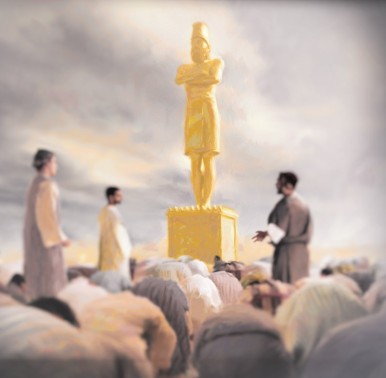 Back in the days of Daniel, when the children of Israel were exiled in Babylon, King Nebuchadnezzar decided to have a 90 foot tall golden statue constructed. The king then commanded that at the proper time all were to bow down and worship this golden image. There were those among the exiles, however, who were faithful to God and would not bow down to the image even though the penalty was death in a fiery furnace (Daniel 3:1-12). These three men, Meshach, Shadrach, and Abed-Nego, were not going to violate their worship to the one true God by bowing down and paying homage to the image Nebuchadnezzar created. Did they not know that this would cost them their physical lives?
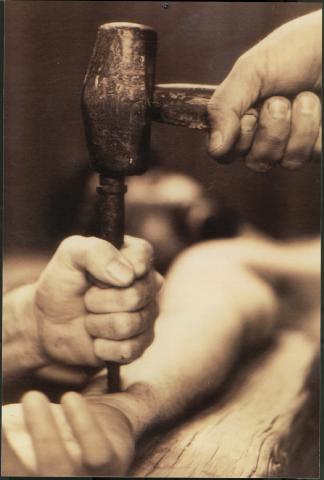 During this time of the year when many people are thinking about the death, burial, and resurrection of Jesus, many might read from Isaiah 53, which predicts the Christ’s ordeal on the cross. Have you ever read that account, however, and wondered about just what it says? In verse 4 we read that Christ was, “Smitten by God, and afflicted” (Isaiah 53:4, NKJV). Later it declares, “And the Lord has laid on Him the iniquity of us all” (Isaiah 53:6). “He was cut off from the land of the living; For the transgressions of My people He was stricken” (Isaiah 53:8). On and on we read within Isaiah’s prophecy about how Jesus was going to be mistreated by mankind. But then we read the statement, “Yet it pleased the Lord to bruise Him; He has put Him to grief” (Isaiah 53:10, emphasis added). Just how could this bloody sacrifice of His one and only unique Son be pleasing to God?
 If someone were to ask you if you love Jesus, what might your response be? Some may want to know who Jesus is. Others may inquire as to what is meant by “love.” There might be those who would want to know why such a question is being asked of them. Yet it is likely that many would say that, yes, they love Jesus. How many of those who say that they love Jesus would also say that they are obeying His commands?
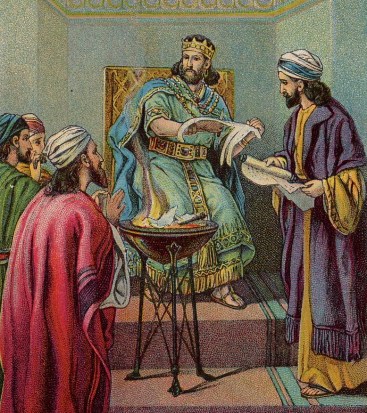 Near the end of the kingdom of Judah, the word of the Lord came to the prophet Jeremiah and he was told to put all the accusations against Israel in Judah into a scroll. The hope of the Lord was that the people in Judah would hear about all the wrong things that were done, which offended God, and that they would repent before it was too late. The scroll was dictated by Jeremiah and written by the hand of Baruch, who was a scribe. After being read in the temple, the scroll was taken to king Jehoiakim, the son of Josiah (Jeremiah 36:1-4, 16).
 Is it acceptable for each of us to do that which is right in our own sight? Are we free to make our own rules for what is right and wrong? Toward the latter section of the book of Judges, we find that there are two phrases that that are oft repeated for emphasis. The first of these is a reminder that there was no king in Israel in those days, and the second is that everyone did what was right in their own sight (Judges 17:6; 18:1; 19:1; 21:25). In these examples we can find the answer to our questions.
 Many times we may hear those in the world refer to salvation by simply praying Jesus into our hearts, or by reciting the ‘sinner’s prayer.’ Is this really all there is to salvation? Is this all that God requires of man for accepting His grace? While there are many places in scripture we could look for the answer to this question, let us consider just one example.
 salvation's path