Do You Love Jesus?

Love     If someone were to ask you if you love Jesus, what might your response be? Some may want to know who Jesus is. Others may inquire as to what is meant by “love.” There might be those who would want to know why such a question is being asked of them. Yet it is likely that many would say that, yes, they love Jesus. How many of those who say that they love Jesus would also say that they are obeying His commands?

     There is a false dilemma that occurs when one begins asking if you are a lover of God and Jesus or if you are a commandment keeper, as if you cannot be both. They might refer to God’s word and state that the keeping of the law is no longer our basis for justification, but that justification comes through the grace of God. “For by grace you have been saved through faith, and that not of yourselves; it is the gift of God, not of works, lest anyone should boast” (Ephesians 2:8, NKJV). That is certainly true with regards to the Mosaic Law of the Old Testament. However, there is a law of Christ that we are to adhere to. Paul, who penned the Ephesian letter, also says in the Galatian letter, “Bear one another’s burdens, and so fulfill the law of Christ” (Galatians 6:2).

     Perhaps we can understand this best by looking at what the Bible actually says about love and commandments. “Therefore you shall love the Lord your God, and keep His charge, His statutes, His judgments, and His commandments always” (Deuteronomy 11:1). Jesus said, “If you love Me, keep My commandments. . . He who has My commandments and keeps them, it is he who loves Me. And he who loves Me will be loved by My Father, and I will love him and manifest Myself to him” (John 14:15, 21).

     If we love the Lord Jesus Christ, we will follow and obey His commandments. That includes His commands to love one another, to put God first in our lives, to seek first His kingdom, to be baptized for the remission of our sins, and to assemble with the saints upon the first day of the week. So, do you love Jesus?

The Thief on the Cross

cross-671379_960_720     Start discussing the biblical requirement to be baptized with someone and see how long it takes before they mention the thief on the cross. Odds are it will not take too long.  That is because there is a widespread doctrine in the religious world that tries to eliminate the need for baptism by appealing to the example of this particular individual, whom Jesus told would be with Him in paradise on the day they both died (Luke 22:43). Just what does this example tell us about salvation? Does the example of the thief on the cross really mean that one does not need to be baptized in order to be saved? Let us look at this issue by noticing three things about this man being forgiven by Christ.

First, the argument is made that the thief was never baptized, and yet Jesus tells him that they will be together in paradise. Is it the case that he was never baptized? How would you prove that? The thief obviously knew something about Jesus and His ministry, for he confesses, ‘. . . we receive the due reward of our deeds; but this Man has done nothing wrong.’ Then he said to Jesus, ‘Lord, remember me when You come into Your kingdom’” (Luke 22:41b-42, NKJV). He knew that Jesus had done nothing wrong, and he had faith in that even though Jesus was hanging on the cross, death would not keep Jesus from receiving His kingdom. How did he know that? Was he a disciple of Christ, perhaps? Had he been baptized by John in the Jordan? It was said of John that, “Then Jerusalem, all Judea, and all the region around the Jordan went out to him and were baptized by him in the Jordan, confessing their sins” (Matthew 3:5-6). Was the thief on the cross in this crowd that John was baptizing? It cannot be proven from scripture that the thief was baptized, but it equally cannot be proven by scripture that he was not.

Second, it should be noted that Jesus had the power to forgive sins while he was on this earth. If Jesus wanted to forgive the thief on the cross based upon his confession of faith, He had the ability to do so. Just look at the example of the paralytic, whom Jesus healed in Mark 2. Unable to reach Jesus in the house because of the crowd that had gathered, the friends of the paralytic man lowered him through the roof so that he could get to Jesus. “When Jesus saw their faith, He said to the paralytic, ‘Son, your sins are forgiven you’” (Mark 2:5). The scribes accused Jesus of blasphemy, since only God could forgive sins. To show that He had the power and authority on earth to forgive sins, Jesus healed the man of his paralysis (Mark 2:6-12). Notice that the text says nothing about whether this man was baptized or not either!

This brings us to the third thing that we want to take notice of regarding both the thief on the cross and any others, whom Jesus forgave while on the earth. While Jesus lived on the earth, the Mosaic Law was in effect. The New Covenant had not yet been offered to anyone. There was a new covenant that was coming, but it did not go into effect until the death of Christ. Jeremiah prophesied about this new covenant between man and God.

Behold, the days are coming, says the Lord, when I will make a new covenant with the house of Israel and with the house of Judah— not according to the covenant that I made with their fathers in the day that I took them by the hand to lead them out of the land of Egypt, My covenant which they broke, though I was a husband to them, says the Lord.  But this is the covenant that I will make with the house of Israel after those days, says the Lord: I will put My law in their minds, and write it on their hearts; and I will be their God, and they shall be My people.  No more shall every man teach his neighbor, and every man his brother, saying, ‘Know the Lord,’ for they all shall know Me, from the least of them to the greatest of them, says the Lord. For I will forgive their iniquity, and their sin I will remember no more (Jeremiah 31:31-34).

This new covenant is the last will and testament of Jesus Christ. As with our own wills, no will or testament is enforced while the one who willed it is alive. A will is only in force after the death of the testator. That is exactly what is said about the new covenant in the Holy Scriptures (Hebrews 9:16-17). Just as the covenant, or agreement, between God and man that was offered at Mount Sinai was sealed in blood, so too would the new covenant between man and God be sealed with the blood of Christ (Hebrews 9:18-22; Luke 22:20).

The new covenant was first offered to mankind on the day of Pentecost, as is recorded for us in Acts 2. If we will obey God and do what He commands, then we can have our sins remitted and have the hope of eternal life with Him. That is the agreement. Notice what Peter says they are to do when asked about how they can be saved. “Then Peter said to them, ‘Repent, and let every one of you be baptized in the name of Jesus Christ for the remission of sins; and you shall receive the gift of the Holy Spirit’” (Acts 2:38). Since the thief on the cross lived and died during the old covenant, and since the new covenant was not offered to anyone until the day of Pentecost, the thief on the cross was not subject to the requirements of the new covenant. But guess who is subject to the new covenant. That’s right! We are!

God’s word could not be clearer on the need for baptism for the remission of our sins in order for us to have salvation. Jesus said, “He who believes and is baptized will be saved; but he who does not believe will be condemned” (Mark 16:16). If He didn’t mean it when He said it, then how would He have said it if He meant it? Jesus said exactly what He meant. He who believes AND is baptized will be saved. For more on God’s Path to Salvation, please click on this link. The fact that the thief on the cross received forgiveness and went to paradise that day does nothing to save our souls. We must be obedient to the One who died for us. We must live according to His will and testament. We are no longer under the Mosaic Law. Don’t take my word for it. See what the scriptures have to say about our belief, obedience, and salvation!

The Sinner’s Prayer

prayer     Many times we may hear those in the world refer to salvation by simply praying Jesus into our hearts, or by reciting the ‘sinner’s prayer.’ Is this really all there is to salvation? Is this all that God requires of man for accepting His grace? While there are many places in scripture we could look for the answer to this question, let us consider just one example.

     The story of the conversion of Saul of Tarsus is fairly well known. Saul was on the road to Damascus when he was surrounded by a bright light and heard a voice from heaven. It was the Lord instructing Saul to go into Damascus, where it would be told to him what he must do in order to be saved. Once he had arrived in Damascus, Saul prayed to the Lord and fasted for three days (Acts 9:8-11). Then Ananias come to Saul and told him, “And now why are you waiting? Arise and be baptized, and wash away your sins, calling on the name of the Lord” (Acts 22:16 NKJV).

     Notice in this account that Saul saw the Lord, he heard the Lord speak, and he prayed and fasted for three days. And yet Saul was not saved from his sins until he was baptized. This should indicate to us that simply trying to pray Jesus into our hearts will not absolve us of our sins. Nowhere in scripture do we find any reference to the ‘sinner’s prayer,’ or the idea of salvation by prayer alone. It should seem obvious that if Saul had to be baptized after his religious experience to have his sins removed, then we must be baptized for the remission of our sins as well.

A Tale of Two Substitutes

tale-of-two-cities     In Charles Dickens’ novel, A Tale of Two Cities, there comes a point where one of the main characters, Charles Darnay, is arrested by the mob during the French Revolution and is sentenced to death. Because of the love that he has for Charles’ wife, Lucie, another character, Sydney Carton, takes Darnay’s place at the guillotine instead. As Carton goes to his death, he utters the most famous line of the novel, “It is a far, far better thing that I do, than I have ever done; it is a far, far better rest that I go to than I have ever known.”

     Just as Sydney Carton substituted himself for Charles Darnay for the sake of love, there is One who has sacrificed Himself for you, because of the love that He has for you. One of the most famous and well known scriptures in the Bible is found in John 3:16, which states, “For God loved the world in this way: He gave His One and Only Son, so that everyone who believes in Him will not perish but have eternal life” (HCSB). Even though we were undesirable, ungodly, weak, and enemies of God at the time, “God demonstrates His own love toward us, in that while we were still sinners, Christ died for us” (Romans 5:8, NKJV). Mankind had separated themselves from God through the tragedy of sin (Isaiah 59:1-2), but because Jesus came and died in our stead, we can now have that hope of eternal life in heaven.

     Because we commit sin, we have the sentence of death in ourselves (Romans 3:23; 6:23). We can do nothing of ourselves to remedy this situation, for we are unable to pay the price. It takes the sacrifice of a sinless life in order for us to be justified before God. What we could not provide for ourselves, God has provided in His Son, Jesus Christ. A greater love than this cannot be found! “Greater love has no one than this, than to lay down one’s life for his friends” (John 15:13). Jesus substituted His sinless life, to die on the cross, to save us from our own spiritual death. Let us obey what He says to do, in His Holy Bible, so that we can apply the blood He shed and wash away our sins (Acts 22:16; Revelation 1:5).

God’s Path to Salvation – Step Five – Be Baptized

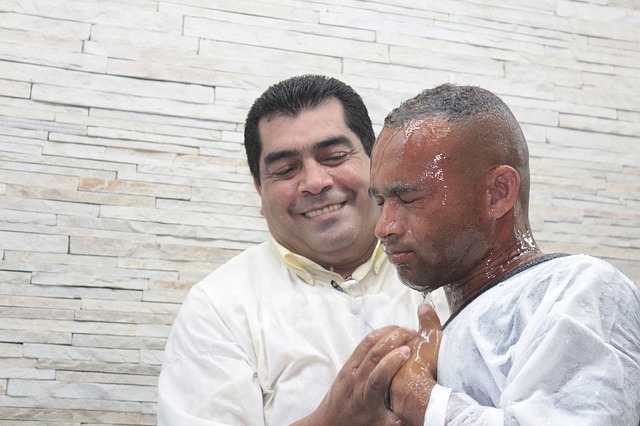
baptism     After hearing and believing the Word, if we are willing to submit to God by confessing our allegiance to Christ and repent of the things we are doing that are wrong, we can become a child of God by being baptized for the remission of our sins.  This step in God’s path to salvation seems to be the most misunderstood and most debated of all of what God requires of us.  Yet, it is a simple step, which the pages of scripture call us to do.  Jesus commands baptism.  The apostles commanded baptism.  Paul was instructed to be baptized.  All of those who converted to Christianity that we can read about in the book of Acts were baptized as part of their conversion.  If you do not believe me, see what God’s Word says about the subject!

     As Jesus was bidding His disciples farewell just before ascending into heaven, He gave them His final instructions.  “And He said to them, ‘Go into all the world and preach the gospel to every creature.  He who believes and is baptized will be saved; but he who does not believe will be condemned’” (Mark 16:15-16NKJV).  Notice here that Jesus states that the one who is a believer and has been baptized will be saved.  It is the same as saying, he who has a ticket and gets into line will be admitted to the game.  We have to have the ticket first in order to get into the game.  If we do not have a ticket, there is no sense in getting into line.  Thus, we have to believe before we are baptized.  If we do not believe, then baptism alone will not affect us.  Additionally, it does us absolutely no good to have a ticket for the game, but to never get into line to enter the building.  Just buying our ticket does not grant us admittance.  Likewise, in order to be saved one must believe and be baptized.

     In Matthew’s recording of the great commission, he writes that Jesus told them to make disciples from all of the nations (Matthew 28:19).  How is it that they were to make disciples?  Jesus tells them how.  He said that they were to baptize them in the name of the Father, Son, and Holy Spirit, and to teach them to observe all of Christ’s commandments (Matthew 28:19-20).  That is how disciples are made.  If you have not been baptized, you are not a disciple (follower) of Jesus Christ.

     It is the act of baptism that washes away our sins.  God did His part in sending His one and only unique Son to die on our behalf, so that our sins might be covered.  Jesus died so that we could be cleansed, sanctified, made holy, and set apart (Romans 5:6-11).  But we also have to do our part in accepting that grace of God.  It is not enough for us to receive a great prize notification, and say that we are rich.  We must claim that prize in order for it to have the intended effect.  It is the act of baptism that puts us in contact with the blood of Christ.  The water has no magical properties, but the act of obedience to what the Lord commanded means that His blood cleanses us from sin.  Paul wrote to the church in Rome, “. . . do you not know that as many of us as were baptized into Christ Jesus were baptized into His death?  Therefore we were buried with Him through baptism into death, that just as Christ was raised from the dead by the glory of the Father, even so we also should walk in newness of life” (Romans 6:3-4).  Being buried with Him in the likeness of His death signifies how we come in contact with the blood He shed, so that our sins can be covered.  Being compared to a burial also tells us of the method of baptism.  It is an immersion, a complete covering.  Otherwise, it is not a burial.

     Peter said that baptism was the act that removes our sins when he preached to the crowd on the day of Pentecost.  On that day the doors of the church were opened for the first time.  Peter explained that those Jews in Jerusalem had been responsible for rejecting Christ and having Him crucified.  They were responsible for His death.  Imagine how they must have felt when Peter showed them that they had put the one and only Son of God to death!  This news pricked them in their hearts.  They were convicted by the word.  They were convinced that they had done wrong.  They wanted to know what they could do to get out of such a terrible predicament (Acts 2:22-37).  “Then Peter said to them, ‘Repent, and let every one of you be baptized in the name of Jesus Christ for the remission of sins; and you shall receive the gift of the Holy Spirit’” (Acts 2:38).  Notice what Peter did not tell them to do.  He did not say to just accept Jesus in your heart and all would be well.  He did not say to repeat a “sinners prayer,” which is not found in Scripture, in order to be saved.  He told them to repent and be baptized.  One is no good without the other.  They were to be baptized for the remission of sins.  Since baptism is the way to remit our sins, if we are not baptized our sins are not remitted.  Later Peter would write that baptism now saves us (1 Peter 3:21).

     One last example to consider is the conversion of Paul.  Paul was a persecutor of the church.  He did not believe in Jesus.  As he was on the way to Damascus to round up more Christians for trial and execution, he saw a bright light and heard the voice of Christ.  Surely that would be enough to save Paul, right?  Notice what Paul was told to do by Jesus.  “Arise and go into the city, and you will be told what you must do” (Acts 9:6b).  So Paul went into Damascus.  There he was told what he must do in order to be saved.  When Ananias came to him, Paul had been praying and fasting for three days (Acts 9:9).  Ananias said to Paul, “And now why are you waiting? Arise and be baptized, and wash away your sins, calling on the name of the Lord” (Acts 22:16).

     Notice that Paul was not saved by seeing Jesus.  He was not saved by speaking to Jesus.  He was not saved by praying and fasting for three days.  If he had been, then why would Ananias have to tell him to be baptized to wash away his sins?  If he had already been saved prior to baptism, there would be no sins that still needed to be washed away.  Notice also that Ananias tells Paul how to call upon the name of the Lord.  You may recall from step one of God’s path to salvation that in Paul’s writing to the Romans in chapter 10 of that letter, Paul told them that those who are saved are those who call upon the name of the Lord.  How do we call upon the name of the Lord?  We do so by obeying Him.  Ananias told Paul that baptism is how we wash away our sins, and how we call upon the name of the Lord.

     The Bible tells us that all of our spiritual blessings are to be found in Christ Jesus (Ephesians 1:3).  Those who are in Christ are no longer condemned (Romans 8:1).  Those who are in Christ are new creatures, having been born again (2 Corinthians 5:17).  Salvation is only to be found in Christ (2 Timothy 2:10).  In Christ, we can have eternal life (1 John 5:11).  So how do we get in Christ in order to receive all of these blessings?  We get in Christ by being baptized into Christ.  “For you are all sons of God through faith in Christ Jesus.  For as many of you as were baptized into Christ have put on Christ” (Galatians 3:26-27, emphasis added).  We must be in Christ to receive the blessings.  We get in Christ by obeying what He has told us to do.  For that, He commanded us to be baptized.

A Desired Result

WaxOnWaxOff     In the 1984 movie The Karate Kid, a young boy who is tired of being bullied comes to Mr. Miyagi to learn karate.  While training him, Mr. Miyagi is shown to have some strange teaching methods.  He has Daniel wash and wax his vehicles, sand the floor of his deck, and paint his fence.  When Daniel doubts that he has learned anything useful, Mr. Miyagi shows him what the motions that his muscles have memorized can do to help him defend himself.

     In the Bible we can read of a similar situation.  Naaman, a commander of the army of Syria, came to Israel to seek out the prophet Elisha in order to be healed of his leprosy (2 Kings 5:1-8).  As he approached Elisha’s house he was met by a messenger who had come from Elisha.  The messenger told Naaman that in order to be cured of his leprosy he must dip in the Jordan seven times (2 Kings 5:9-10).

     Naaman was furious.  He thought that Elisha would wave his hand all over the place and make a great show in calling on the name of God.  Instead, Elisha has sent his word by a messenger.  To top it all off, Naaman was told to dip in the dirty Jordan river, not the much better rivers back home in Syria (2 Kings 5:11-12).  Nevertheless, Naaman did what the prophet instructed him to do, and his leprosy was healed (2 Kings 5:13-14).  Like Daniel with Mr. Miyagi, Naaman learned that simple obedience produced a desired result.

     How is it with us?  Do we expect to be tapped on the shoulder by God and told what to do?  At one time God spoke with man either directly or through the prophets, but now He speaks to us by His Son (Hebrews 1:1-2).  Jesus’ message for salvation is simple, “he who believes and is baptized will be saved” (Mark 16:16a NKJV).  We may be looking for a grander scheme, but why not simply obey what God has said to do.  After all, it worked out pretty well for Naaman!

Life Is In The Blood

George Washington     In December 1799 George Washington passed from this life.  He had been out taking care of his property in foul weather and had come down with what would appear to be a cold (sore throat, congestion, etc.).  In an effort to save the former president, his doctors took to opening veins and “bleeding” him, which was believed at the time to be the way to get the illness out of his system.  What the doctors of the time failed to realize is that life is in the blood.

     Man cannot sustain his physical life without blood.  This was well known to the Israelites, or should have been, since God forbade the eating of blood because “life is in the blood. . .” (Leviticus 17:11a NKJV).  Human medicine has come to realize the importance of blood in sustaining life in the years following Washington’s death.  Now, much can be done with transfusions to help stabilize patients who have suffered a loss of blood.

     In looking at man’s spiritual life, it can be seen that our spiritual life is also in the blood.  The Scriptures tell us that we have all sinned (Romans 3:23), and that the wages, the anticipated payment, of sin is spiritual death (Romans 6:23).  We know that this is not in reference to physical death, for we must all be subject to that unless the Lord returns first (Hebrews 9:27).  In order to have spiritual life, an eternity in heaven, we must have our sins covered by the blood of Christ (1 John 1:7; Revelation 1:5).

     We make contact with the blood of Christ when we are buried with Him in the act of baptism (Romans 6:3-4).  In obeying the command of Christ to be baptized (Mark 16:16), we can have our sins washed away (Acts 2:38; 22:16).  It is in our obedience to the words of Scripture, that the blood of Christ is applied to us and we are cleansed from our sins.  Thus, we are able to have spiritual life.  Thus, both our physical life and our spiritual life are in the blood!

Baptized in the Spirit. . . A Closer Look

the%20holy%20spirit

     In Acts 2 we see the account of the birth of the church when the Holy Spirit fell on the apostles and they were filled with power (Acts 2:1-4).  Many have looked at this passage and are not sure, however, of whether the Spirit fell only on the apostles, or if He fell on the 120 mentioned previously (Acts 1:15).  So then, who did receive the baptism of the Holy Spirit in Acts 2?  Was it the 120 who were in the upper room when the replacement for Judas was chosen, or was it just the apostles?

     First let’s examine who was given the promise of the Holy Spirit by Jesus.  When Jesus promises to send the Holy Spirit (Acts 1:5, 8) and to baptize them in it, to whom was He speaking?  In order to find the antecedent of them, we need to look back at Acts 1:2.  Here Luke tells us that the them in this context are the apostles that Jesus had chosen.  Therefore the promise of Jesus to send the baptism of the Holy Spirit was given to the apostles.  They were the ones to receive the promise and watch Jesus ascend into heaven (Acts 1:11).

     Second let’s examine the time frame with regards to the promise and the coming of the Holy Spirit upon them.  After witnessing the ascension of Jesus into heaven, the apostles traveled a ‘Sabbath day’s journey’ (fixed at 2,000 cubits or roughly 1,000 yards) back to Jerusalem.  Thus they would have arrived back in Jerusalem on the same day in which Jesus ascended and met with the others mentioned in the upper room there (Acts 1:12-17).  Since we see that Jesus was with His apostles for 40 days after His resurrection (Acts 1:3), and since we know that Jesus was in the tomb for 3 days, we can accurately calculate that it had been 43 days since the death of our Lord on the cross when this event with the 120 in the upper room takes place.  Since we also know that there are 50 days between the Passover (time of the crucifixion) and the day of Pentecost, we can see that this meeting took place one full week prior to the day of Pentecost.  The importance of the calculation of the days is that it shows that the narrative of the 120 in the upper room was not on the same day as Pentecost, when the Holy Spirit fell upon the apostles.

     Third let’s examine the event of the Holy Spirit falling upon them on the day of Pentecost.  In looking at Acts 2:1-4 the Bible tells us that they were all together in one place (it does not specify where that place is – upper room, temple, marketplace, etc.).  The Holy Spirit fell upon them and they began to speak in tongues.  Again we need to find the antecedent of them and they in this passage.  This is found by looking at the last verse of Acts 1.  Here we read that the lot fell upon Matthias and he was numbered with the other eleven apostles.  This is to whom the they at the beginning of Acts 2 is in reference.   They were the 12 apostles and it was upon them that the baptism of the Holy Spirit was given, fulfilling the promise made by Jesus in Acts 1:5, 8.

     Through the rest of the book of Acts we can see that the apostles had the ability to heal sickness, cast out demons, and transfer spiritual gifts by the laying on of their hands.  Once the apostles passed from this life, however, those spiritual gifts and that miraculous ability also passed away.  The working of miracles to confirm the word of God had accomplished the task given to them, mainly to confirm that the words spoken by the apostles and prophets were true and were from God (Mark 16:20).  We today have the written word, which we can read and examine to see that these things are so.