Why Was God Pleased to Injure Christ?

nails     During this time of the year when many people are thinking about the death, burial, and resurrection of Jesus, many might read from Isaiah 53, which predicts the Christ’s ordeal on the cross. Have you ever read that account, however, and wondered about just what it says? In verse 4 we read that Christ was, “Smitten by God, and afflicted” (Isaiah 53:4, NKJV). Later it declares, “And the Lord has laid on Him the iniquity of us all” (Isaiah 53:6). “He was cut off from the land of the living; For the transgressions of My people He was stricken” (Isaiah 53:8). On and on we read within Isaiah’s prophecy about how Jesus was going to be mistreated by mankind. But then we read the statement, “Yet it pleased the Lord to bruise Him; He has put Him to grief” (Isaiah 53:10, emphasis added). Just how could this bloody sacrifice of His one and only unique Son be pleasing to God?

     There are many events recorded in the Bible, with which God was not pleased. He was not pleased with the idolatry of the Israelites. Whether at the base of Mount Sinai during their exodus from Egypt, in the high places during the time of the divided kingdom, or in the temple during the reign of Manasseh, God was not pleased with idolatry. There were times when the Israelites did not offer their best in sacrifice to God, but instead brought the lame and sick as a sacrifice (Malachi 1:8; 3:8-9). In this God was not pleased, because their heart was not in what they were doing, and they were not showing God the proper respect. “Therefore, when He [Jesus] came into the world, He said: ‘Sacrifice and offering You did not desire, But a body You have prepared for Me. In burnt offerings and sacrifices for sin You had no pleasure’” (Hebrews 10:5-6). Here Jesus is saying to the Father that the Father did not desire or have pleasure in burnt offerings and sacrifices.

     So what are we to make of this? God did not have pleasure or desire for burnt offerings and sacrifices, which He commanded, but it pleased the Lord to bruise Christ. Even though God commanded the children of Israel to make burnt offerings and sacrifices, He did not take pleasure in them. Their sacrifices represented failure on their part to keep His law. They were required because of the sins of the people. They were necessary because mankind will always fall short. God takes no pleasure in man’s sin. This is why God through the prophet Samuel says, “Has the Lord as great delight in burnt offerings and sacrifices, As in obeying the voice of the Lord? Behold, to obey is better than sacrifice” (1 Samuel 15:22). God would rather that man obey Him than to make the best animal sacrifice he could offer. God also did not have pleasure in burnt offerings and sacrifices because they could not get the job done. Just before stating that God has no desire for nor pleasure in those offerings, the Hebrew account tells us plainly, “For it is not possible that the blood of bulls and goats could take away sins” (Hebrews 10:4). Those animal sacrifices could not take sin away and could not make those who offered them perfect with regards to the conscience (Hebrews 9:9; 10:1-3). There was still a remembrance of those sins, and so year after year the High Priest would enter the Most Holy Place with the blood of the sacrifice (Hebrews 9:7). God was not pleased because the reconciliation between God and man was not complete.

     By contrast then, God was pleased with the sacrifice of Christ. Because of what Jesus did for mankind by dying on the cross as our perfect offering, there is a cleansing of the conscience and the sins of man are remembered no more (Jeremiah 31:31-34; Hebrews 8:12). The sacrifice of Jesus was perfect and complete. There no longer remains a need for another sacrifice, because Jesus offered Himself for us once for all (Hebrews 9:11-15). Because of the redemptive work of Christ, man and God are reconciled to one another (Ephesians 2:16). In this the Lord is pleased. This is how God can say that He was pleased to bruise Jesus for our transgressions. It is not that He was pleased by Christ having to endure the cross and the pain and the shame. But God was pleased in the result in that mankind has a path back to the Father. Will you follow God’s Path to Salvation? Will you take the only way that we can go to find eternal life (John 14:6)? God has done His part by offering His one and only unique Son for our behalf (John 3:16). In this He was pleased. Will you do your part to accept His sacrifice and apply the blood to cover your sins through simple obedience to the Gospel? If you want to be pleasing to God, you will.

The Compassion of Christ

Jesus Heals Leper     Many of us cannot imagine what it would be like to have to live as a leper in ancient times.  Just take a moment to consider what our mental and emotional state would be if we knew we had a disease that could not be cured and that mandated that we be isolated.  Lepers could not live among their loved ones, due to the disease being contagious.  They had to live in separate colonies.  They had to pass by people on the other side of the street and yell out “unclean,” so no one would come near them.  Certainly, no one would ever touch a leper.

     Now notice what Matthew records for us with regards to one who was a leper in ancient times. “And behold, a leper came and worshiped Him, saying, ‘Lord, if You are willing, You can make me clean.’ Then Jesus put out His hand and touched him, saying, ‘I am willing; be cleansed.’ Immediately his leprosy was cleansed” (Matthew 8:2-3, NKJV).  In this event Jesus is shown to have power that mortal men do not have.  Leprosy was an incurable disease, but Jesus had the power to heal this man.  We might also notice that the miracle Jesus performed did not take time to become effective, but that the cure to this man’s leprosy was immediate.  Therefore, there can be no doubt as to how the man was healed.

     There is another aspect of this occasion, however, that is often overlooked.  That is the compassion of Christ.  As previously noted, lepers could not have any physical contact with others, but look at what Jesus did.  The Bible says that Jesus reached out His hand and touched this man.  It can be seen in other miracles that Jesus performed that the touching of this man was unnecessary in order to heal him.  Indeed, Jesus later healed the Centurion’s servant from a distance.  So why did Jesus reach out and touch him?  I believe that Jesus touched him to show His compassion on this man.  Christ has compassion for His children.

     Perhaps you have something in your life that no one else can help you with, and you need compassion too.  Maybe you need that comfort that only God can afford.  We invite you to come and see the compassion of the Christ, to learn more about Him, and to become a child of God by being born again (John 1:12-13; 3:3-7).

The Greatest Gift!

3703145222_428db0fdbc_z     Christmas morning!  I remember as a child, my brother and I could hardly sleep the night before in anticipation of the gifts that we would find under the tree.  Invariably, there was always one “big” gift each year, which we would open last.  To build the anticipation, my dad would keep egging us on by saying, “I wonder what’s in that big box.”  As a child, I definitely enjoyed receiving gifts on Christmas.

     As I grew older, I came to realize that there was more joy in giving than in receiving.  To witness the merriment in someone else’s face as they open the gift that you have selected for them was a good feeling that far surpassed whatever I might receive.  Paul understood this to be true as well, when he quoted the words of Jesus that it is more blessed to give than to receive (Acts 20:35).

     As we search the stores and websites in our modern age, from Black Friday to Christmas Eve, we are looking for just the right gift, the perfect gift, the greatest gift that we can give our loved ones.  As we live here on earth, we should realize that God has given us that perfect gift.  He has given us the greatest gift.  He has given us His Son.  “For God so loved the world that He gave His only begotten Son, that whoever believes in Him should not perish but have everlasting life” (John 3:16 NKJV).   God has given us a gift to pay our debt of sin; a debt that we could never repay.  By the blood of Jesus, we can have redemption.

     As we gather with our families and friends on this holiday, we should remember the God who gave us that greatest gift.  Indeed we should always remember the God who loved us so much that He sent His Son Jesus to die for us on the cross of cavalry.  It is by Jesus’ blood that we can have the hope of eternal life with Him in heaven.  You won’t find a better gift than that under anybody’s tree this morning!

Hammer Away

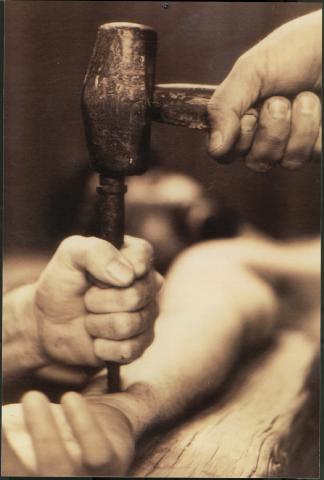
nails     My last remodeling project got me thinking.  As we were going through the process of deconstruction and trying to be careful to limit the amount of scratches and bruises, I began to think about installing the new floor.  You see, when we undertake any project where we are going to be using a hammer and nails it has our full attention.  We don’t want to slip up and hit our fingers or worse yet, pierce our flesh with a nail by mistake.

      Now think about Christ and what He did for us.  He had the power to stop anyone from doing any harm to His body, but He did not exercise that power.  At any time during His mockery of a trial, the scourging of His body, or the nailing of His body on that cross of Cavalry Jesus could have simply said the word ‘stop’ and could have brought His torture to an end.  Concerning His life, Jesus said “No one takes it from Me, but I lay it down of Myself. I have power to lay it down, and I have power to take it again. This command I have received from My Father” (John 10:18 NKJV).

      No one had the power to take Jesus’ life unless He allowed it.  The amazing thing about His love for us in that Jesus allowed those Roman soldiers to take His life.  At a time when we were without hope, at a time when we were still sinners, Christ died for our sins (Romans 5:8).  We work hard to make sure that we don’t slip and allow a nail to poke us in the hand by mistake, but Jesus allowed them to drive large nails through His flesh on purpose.  It is hard to comprehend just what Jesus suffered on our behalf.  So then, are we allowing that sacrifice to have an impact on how we live our lives?

Kingdom Come?

Left Behind CageMany of us are looking forward to Jesus’ return with great anticipation. Regarding that return, there are many who expect Christ to set up an earthly kingdom and reign from Jerusalem for 1,000 years. Indeed, later this week a new movie based on the popular “Left Behind” series opens in theaters, which espouses this idea of Jesus’ coming kingdom. Is this really what the Bible teaches, or is it just good fiction?  Let us look at just a few scriptures to ascertain the answer to that question.

Long ago Joel prophesied that in the last days God would pour His Spirit upon mankind (Joel 2:28ff). In Acts 2, Peter makes mention of Joel’s prophecy and says that they were living in those last days that Joel was referring to (Acts 2:16-21).  So we know from this that the last days began some 2,000 years ago on that day of Pentecost.  Additionally, we see that Jesus told those who were listening to Him that some of them would not experience death until they had seen the kingdom come with power (Mark 9:1).  Just prior to Jesus’ ascension He told His disciples to tarry in Jerusalem until they received power from the Holy Spirit (Acts 1:4-5).  About a week later, they received the Holy Spirit on the day of Pentecost in Acts 2.  Therefore, they received the power when the Spirit fell upon them.  When the power came the kingdom came.

Furthermore, in reviewing Daniel 2, and the explanation of Nebuchadnezzar’s dream, Daniel describes four earthly kingdoms. The first of these is Babylon, followed by the Medes and the Persians.  Later would be the Greeks and then the Roman Empire. Then Daniel states that in the days of those kings God would set up a kingdom that would never be destroyed (Dan. 2:44).  This is further confirmation that the kingdom would be established during the days of the Roman Empire and was also fulfilled on the day of Pentecost as described in Acts 2.  Just as Jesus told Pilot, His kingdom was not of this earth but that it was a spiritual kingdom (John 18:36).

So then, what do we learn by putting some of these scriptures together? We see that there were some who lived 2,000 years ago that were not going to die before the kingdom came with power.  We see that power came when the kingdom was established on the day of Pentecost, and we see that the kingdom is a spiritual kingdom which is the church.  Christ came to seek and save the lost and to add them to His kingdom, the church, and He was successful in that mission.  Therefore, the kingdom that we are to seek entry into has been established for the past 2,000 years, and it is the church which Jesus built (Mat.16:18).

Who is This Jesus?

who-am-i

People may often wonder about Jesus and who He really was.  It has been said by some that Jesus was just a good man, or that He was only a prophet, but that He was not the Son of God.  What evidence do we find in God’s word about who Jesus really was?  When Jesus and His disciples approached the region of Caesarea Philippi He asked them what the people thought about who He was.  They answered Him that some thought that He might be John the Baptizer, Elijah, Jeremiah, or one of the prophets.  However, when He asked His apostles who He was, “Simon Peter answered and said, ‘You are the Christ, the Son of the living God’” (Matthew 16:16 NKJV).

How did Peter know who Jesus really was?  One reason is that Peter had been travelling with Jesus for some time and had seen the things that Jesus was able to do.  Some of what Peter had seen is recorded for us in Matthew chapter 8, which chronicles several of the miracles of Jesus.  In this chapter we can see that Jesus exhibited power that mere men or prophets simply did not have.  Specifically, there are 5 such miracles that demonstrate the power of Jesus over several aspects of life.

The miracles of Jesus in chapter 8 of the book of Matthew include the following:

  1. The healing of the leper (Mat. 8:1-4), which demonstrates Jesus’ power over the seen or external world.  All could see that the leper had the disease, but no one else could have healed him other than God.
  2. The healing of Peter’s mother-in-law (Mat. 8:14-15), which demonstrates Jesus’ power over the unseen or internal world.  She had a fever, and while others may be able to tell by her demeanor that she was ill, none but God could see the internal cause of the fever.
  3. The healing of the centurion’s servant (Mat. 8:5-13), which demonstrates Jesus’ power over time and space.  It was not necessary for Jesus to travel to the centurion’s home to heal the servant, He was able to do it from a distance.  This shows that Jesus had a power that mortal man does not posses.
  4. The calming of the storm at sea (Mat. 8:23-27), which demonstrates Jesus’ power over nature.  No mere man could have accomplished this feat as even His disciples exclaimed, “Who can this be, that even the winds and the sea obey Him?” (Matthew 8:27b).
  5. The casting out of demons (Mat. 8:28-32), which demonstrates Jesus’ power over the spiritual realm.  Again this shows that Jesus was more than a man and that He really was the Son of God.

We see that the purpose of miracles was to confirm the message that was spoken (Mark 16:20).  Therefore, it is not unusual that Matthew shows these 5 miracles here in chapter 8 as Jesus has just finished delivering the Sermon on the Mount (Mat. 5-7).  Indeed, at the end of that great sermon the people realized that Jesus was not like other men.  “And so it was, when Jesus had ended these sayings, that the people were astonished at His teaching, for He taught them as one having authority, and not as the scribes” (Mat. 7:28-29).  Thus the miracles of Jesus help to prove to us just who He really is, that being the Son of God and a member of the Godhead.

Who Do You Love?

            Suppose that someone were to ask the question, who do you love?  What would our answer be?  Who would be at the top of our list?  Most likely those we would think of first would be the people who love us in return.  Hopefully God would be at the top of that list as well.  But would any of us have mentioned people who openly hate us?  If we are being honest, probably not many of us would have answered that way.

            Let us consider for a moment what is written for our learning in Romans 5:6-11.  In this passage we are reminded that when we were without strength, when we were unrighteous, when we were yet sinners, and when we were enemies of God, He sent His only Son to die on the cross for us.  Imagine sending your only child to die for the benefit of people that hate you.  Could you do it?  This passage says “but God” showed His love for us by sending Christ to die for our sins while we were less than unworthy (v. 8).

            If we only love those who love us, we are no better than the heathen (Matthew 5:46-47).  Instead Jesus encourages us to love our enemies and to strive to do good to all men.  If we would be willing to share the good news of the gospel with anyone, no matter if they love us or hate us, what better way could there be to show our love and concern for them and their eternal soul?