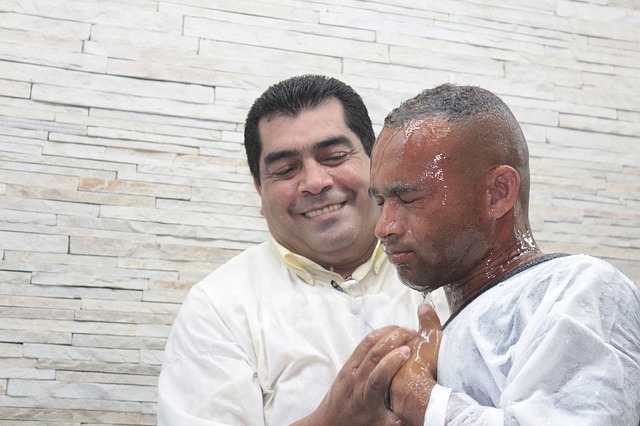
 After hearing and believing the Word, if we are willing to submit to God by confessing our allegiance to Christ and repent of the things we are doing that are wrong, we can become a child of God by being baptized for the remission of our sins. This step in God’s path to salvation seems to be the most misunderstood and most debated of all of what God requires of us. Yet, it is a simple step, which the pages of scripture call us to do. Jesus commands baptism. The apostles commanded baptism. Paul was instructed to be baptized. All of those who converted to Christianity that we can read about in the book of Acts were baptized as part of their conversion. If you do not believe me, see what God’s Word says about the subject!
As Jesus was bidding His disciples farewell just before ascending into heaven, He gave them His final instructions. “And He said to them, ‘Go into all the world and preach the gospel to every creature. He who believes and is baptized will be saved; but he who does not believe will be condemned’” (Mark 16:15-16NKJV). Notice here that Jesus states that the one who is a believer and has been baptized will be saved. It is the same as saying, he who has a ticket and gets into line will be admitted to the game. We have to have the ticket first in order to get into the game. If we do not have a ticket, there is no sense in getting into line. Thus, we have to believe before we are baptized. If we do not believe, then baptism alone will not affect us. Additionally, it does us absolutely no good to have a ticket for the game, but to never get into line to enter the building. Just buying our ticket does not grant us admittance. Likewise, in order to be saved one must believe and be baptized.
In Matthew’s recording of the great commission, he writes that Jesus told them to make disciples from all of the nations (Matthew 28:19). How is it that they were to make disciples? Jesus tells them how. He said that they were to baptize them in the name of the Father, Son, and Holy Spirit, and to teach them to observe all of Christ’s commandments (Matthew 28:19-20). That is how disciples are made. If you have not been baptized, you are not a disciple (follower) of Jesus Christ.
It is the act of baptism that washes away our sins. God did His part in sending His one and only unique Son to die on our behalf, so that our sins might be covered. Jesus died so that we could be cleansed, sanctified, made holy, and set apart (Romans 5:6-11). But we also have to do our part in accepting that grace of God. It is not enough for us to receive a great prize notification, and say that we are rich. We must claim that prize in order for it to have the intended effect. It is the act of baptism that puts us in contact with the blood of Christ. The water has no magical properties, but the act of obedience to what the Lord commanded means that His blood cleanses us from sin. Paul wrote to the church in Rome, “. . . do you not know that as many of us as were baptized into Christ Jesus were baptized into His death? Therefore we were buried with Him through baptism into death, that just as Christ was raised from the dead by the glory of the Father, even so we also should walk in newness of life” (Romans 6:3-4). Being buried with Him in the likeness of His death signifies how we come in contact with the blood He shed, so that our sins can be covered. Being compared to a burial also tells us of the method of baptism. It is an immersion, a complete covering. Otherwise, it is not a burial.
Peter said that baptism was the act that removes our sins when he preached to the crowd on the day of Pentecost. On that day the doors of the church were opened for the first time. Peter explained that those Jews in Jerusalem had been responsible for rejecting Christ and having Him crucified. They were responsible for His death. Imagine how they must have felt when Peter showed them that they had put the one and only Son of God to death! This news pricked them in their hearts. They were convicted by the word. They were convinced that they had done wrong. They wanted to know what they could do to get out of such a terrible predicament (Acts 2:22-37). “Then Peter said to them, ‘Repent, and let every one of you be baptized in the name of Jesus Christ for the remission of sins; and you shall receive the gift of the Holy Spirit’” (Acts 2:38). Notice what Peter did not tell them to do. He did not say to just accept Jesus in your heart and all would be well. He did not say to repeat a “sinners prayer,” which is not found in Scripture, in order to be saved. He told them to repent and be baptized. One is no good without the other. They were to be baptized for the remission of sins. Since baptism is the way to remit our sins, if we are not baptized our sins are not remitted. Later Peter would write that baptism now saves us (1 Peter 3:21).
One last example to consider is the conversion of Paul. Paul was a persecutor of the church. He did not believe in Jesus. As he was on the way to Damascus to round up more Christians for trial and execution, he saw a bright light and heard the voice of Christ. Surely that would be enough to save Paul, right? Notice what Paul was told to do by Jesus. “Arise and go into the city, and you will be told what you must do” (Acts 9:6b). So Paul went into Damascus. There he was told what he must do in order to be saved. When Ananias came to him, Paul had been praying and fasting for three days (Acts 9:9). Ananias said to Paul, “And now why are you waiting? Arise and be baptized, and wash away your sins, calling on the name of the Lord” (Acts 22:16).
Notice that Paul was not saved by seeing Jesus. He was not saved by speaking to Jesus. He was not saved by praying and fasting for three days. If he had been, then why would Ananias have to tell him to be baptized to wash away his sins? If he had already been saved prior to baptism, there would be no sins that still needed to be washed away. Notice also that Ananias tells Paul how to call upon the name of the Lord. You may recall from step one of God’s path to salvation that in Paul’s writing to the Romans in chapter 10 of that letter, Paul told them that those who are saved are those who call upon the name of the Lord. How do we call upon the name of the Lord? We do so by obeying Him. Ananias told Paul that baptism is how we wash away our sins, and how we call upon the name of the Lord.
The Bible tells us that all of our spiritual blessings are to be found in Christ Jesus (Ephesians 1:3). Those who are in Christ are no longer condemned (Romans 8:1). Those who are in Christ are new creatures, having been born again (2 Corinthians 5:17). Salvation is only to be found in Christ (2 Timothy 2:10). In Christ, we can have eternal life (1 John 5:11). So how do we get in Christ in order to receive all of these blessings? We get in Christ by being baptized into Christ. “For you are all sons of God through faith in Christ Jesus. For as many of you as were baptized into Christ have put on Christ” (Galatians 3:26-27, emphasis added). We must be in Christ to receive the blessings. We get in Christ by obeying what He has told us to do. For that, He commanded us to be baptized.


 salvation's path