 Over the course of the past two weeks there has been much discussion to be found regarding the issue of marriage and the Supreme Court’s decision to legalize gay marriage in all fifty states. Additionally, there has been a wide range of responses offered by the Christian community. There have been some who have embraced the high court’s mandate, others have railed hard against it, and a third group has declined to address the issue. It leads us to wonder just what should the Christian’s reaction be to what is going on?
If we are to be Christians, then we need to speak where the Bible speaks. If we only looked at Romans 1 we would be able to get a picture of what God says about homosexuality. Paul writes, “For this reason God gave them up to vile passions. For even their women exchanged the natural use for what is against nature. Likewise also the men, leaving the natural use of the woman, burned in their lust for one another, men with men committing what is shameful, and receiving in themselves the penalty of their error which was due” (Romans 1:26-7 NKJV). He starts off by saying for this reason. It is because mankind has ignored God, even though they once knew Him, and even though there is evidence in the creation to point to Him. Because they have rejected God, He has allowed them to walk away. They have instead been given over to vile passions.
In looking at this passage we should notice four things about God’s opinion of homosexuality. First, He calls it a vile, or degrading passion. This word can also mean dishonorable, disgraceful, or shameful. This is not something that God sees as desirable. Second, He calls it unnatural. This is simple science and biology. Nature itself declares that the union of woman with woman or man with man is unnatural. Their bodies are not designed to fit together as God intended. Thus, nature even shows us the compatibility of man’s body with that of woman, and that is the only way to procreate and bring forth a child. Third, God calls homosexuality shameful. That which is shameful is an indecent act; it is unseemly. This particular word is never used for anything that is acceptable to God, but instead refers to that which is rejected by God. Man has acceptable passions, but lust for another man is not one of those. Fourth, He calls homosexuality an error. The Greek word here also indicates that it is a perversion, a delusion or deceit. It shows a deviation or leaving of God’s Divine pattern. It says that they receive “in themselves the penalty of their error.” Could this be a reference to STD’s and particularly the AIDS virus?
If we are to go by God’s word, then we cannot rejoice or embrace the decision. There are many on Facebook and other social media outlets who are expressing joy over the decision, because now their gay friends can get married. They change their profile pictures to show a rainbow to illustrate their support. This is not Christian behavior. The Christian cannot rejoice or embrace what God has condemned and described as degrading, unnatural, indecent, and error. The Bible is clear that God will punish those who practice such activities, but will also hold those who approve of them just as guilty as those engaged in the act (Romans 1:32).
While we are called to preach the truth, we are to do it in love. This does not mean that we are to soft peddle the truth. This does not mean that we are to shy away from what we have to say. God said that we are to love one another (see the whole letter of 1 John). But there is a vast difference in that Agape, all encompassing, self-sacrificing, love that God wants us to have, and the erotic love that is only meant to be shared between a husband (male) and his wife (female). Imagine that you saw someone in a burning house. How would you react? Would you call out, “Hey, friend. Maybe sometime we should talk about the danger of fire.” Are we to think that we cannot call out in haste that they need to flee the burning building now? Do we think that we are being hateful by telling them to get out now? Then why would it be hateful to point out to them their lost condition and their need to escape from the eternal flames of hell? If we truly love people the way the God described, then we need to tell them what is best for them to know. If those who claim to love their “partner” really loved them, then they should be willing to change their relationship in order for that person to make it to heaven. God makes it clear that homosexuals will not inherit the kingdom of heaven (1 Corinthians 6:9-10). But then He says, “And such were some of you. But you were washed, but you were sanctified, but you were justified in the name of the Lord Jesus and by the Spirit of our God” (1 Corinthians 6:11). They were able to change their lifestyle and be sanctified and made holy. If they could do it then, people can do it now.
We cannot just ignore the issue and hope it will go away. Some do not want to address the issue for fear of appearing as if this is all that Christians talk about. We don’t want to single out one sin and ignore all the others. However, no one is trying to force us to accept the lifestyle of murderers as normal. No one is telling our first graders that lying is just an alternate method of communication. No one is mandating that we never speak out against those living in adultery, or else be accused of hate speech. While I would agree that this is not the only sin, and that it is not any more important than any other sin, it is one that the world wants us to accept and embrace as normal, and that does make it different. We have an obligation to speak the truth in love, but sometimes we swing the pendulum too far in one direction or the other. We do need to speak out on this issue. If we do not, then who will warn the world? See Ezekiel 3:17 and Matthew 5:13-16.
Why does it matter? Many will ask the question of the Christian, “Why do you care if two people get married?” “How does that affect you?” Here is the thing. To be a Christian means that you belong to Christ. He is your Lord and Master. How can we then divorce ourselves from God and act as if something that He has called an abomination has no affect on us? Can we really ignore or rejoice over something that grieves God’s Holy Spirit, and still call ourselves one of His? (Isaiah 63:10; Ephesians 4:30). It matters because of our struggle against the darkness of this world. “For we do not wrestle against flesh and blood, but against principalities, against powers, against the rulers of the darkness of this age, against spiritual hosts of wickedness in the heavenly places” (Ephesians 6:12). Our struggle is for the souls of mankind, and in that struggle we must be on God’s side if we are to be one of His children.
Additionally, it matters because as a nation we will all be subject to the consequences of God’s wrath. When the Israelites conquered Jericho they were told not to take of the accursed things that were in Jericho. However, Achan took of the spoils and the whole camp was affected by the punishment for that sin (Joshua 7). When God’s patience ran out on the nation of Israel and all of their idolatry, they were taken away into the Babylonian captivity. Not all of the Israelites were guilty of idolatry, but they still suffered the consequences of the sins of that nation. Today, we say, “Well, what affect does it have on me if two men want to get married?” Make no mistake about it, God will punish sin. “Righteousness exalts a nation, But sin is a reproach to any people” (Proverbs 14:34). God’s patience eventually ran out with Babylon, Persia, Greece, Rome, and Israel. You can read about that in the pages of the Old Testament. When God decides that His patience with America has run out, it will affect us all. It is up to us to try to return our nation to the principles of God before it is too late. It would do us well to heed the words of God, “If My people who are called by My name will humble themselves, and pray and seek My face, and turn from their wicked ways, then I will hear from heaven, and will forgive their sin and heal their land” (2 Chronicles 7:14). Marriage matters to us, because marriage matters to God.
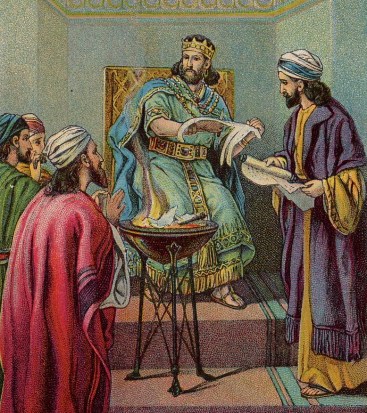 Near the end of the kingdom of Judah, the word of the Lord came to the prophet Jeremiah and he was told to put all the accusations against Israel in Judah into a scroll. The hope of the Lord was that the people in Judah would hear about all the wrong things that were done, which offended God, and that they would repent before it was too late. The scroll was dictated by Jeremiah and written by the hand of Baruch, who was a scribe. After being read in the temple, the scroll was taken to king Jehoiakim, the son of Josiah (Jeremiah 36:1-4, 16).


![John 1717 [widescreen]](https://salvationspath.com/wp-content/uploads/2015/03/john-1717-widescreen.png)

 salvation's path