Do This in Remembrance of Me

grapes     Recent research has suggested that the consumption of grape juice is an aid in either avoiding Alzheimer’s, or that it can slow the process of memory loss in those with the brain disease. Alzheimer’s is thought to be brought on by stress and free radicals in a person’s physiology. Since antioxidants combat free radicals, and since grape juice is rich in antioxidants, the thought is that grape juice can help combat one of the causes of the disease (http://www.ncbi.nlm.nih.gov/pmc/articles/PMC3544087).

     Is it not interesting to think that grape juice can aid memory? Just before He was arrested, tried, and convicted to die via crucifixion, Jesus gathered with His disciples in an upper room in order to partake of the Passover. At this last supper of the Lord, Jesus instituted the Lord’s Supper. They took the cup containing the fruit of the vine (grape juice) and divided it amongst themselves. Then Jesus explained to them how the unleavened bread represented His body, which would be given for them and us. That cup with the fruit of the vine represented His blood, which would be shed for the forgiveness of sins (Luke 22:17-20). During that discourse, Jesus instructed them to “do this in remembrance of Me” (Luke 22:19b, NKJV).

     Every week, on the first day of the week, Christians around the world gather together to remember the sacrifice of Christ (Acts 20:7). One of the emblems that is used in this remembrance is the fruit of the vine/grape juice, which researchers now believe is an aid to memory! Of all the things that we have to remember, from time with our friends as children, to time spent with loved ones as we grow old, what can we remember that could ever be more important than what God did for us by sending Christ to die in our place? God, who knows all things, chose to use unleavened bread and grape juice as the symbols to remember Jesus death. “For as often as you eat this bread and drink this cup, you proclaim the Lord’s death till He comes” (1 Corinthians 11:26). So the next time you enjoy a glass of grape juice, remember what Jesus did for you.

Why Was God Pleased to Injure Christ?

nails     During this time of the year when many people are thinking about the death, burial, and resurrection of Jesus, many might read from Isaiah 53, which predicts the Christ’s ordeal on the cross. Have you ever read that account, however, and wondered about just what it says? In verse 4 we read that Christ was, “Smitten by God, and afflicted” (Isaiah 53:4, NKJV). Later it declares, “And the Lord has laid on Him the iniquity of us all” (Isaiah 53:6). “He was cut off from the land of the living; For the transgressions of My people He was stricken” (Isaiah 53:8). On and on we read within Isaiah’s prophecy about how Jesus was going to be mistreated by mankind. But then we read the statement, “Yet it pleased the Lord to bruise Him; He has put Him to grief” (Isaiah 53:10, emphasis added). Just how could this bloody sacrifice of His one and only unique Son be pleasing to God?

     There are many events recorded in the Bible, with which God was not pleased. He was not pleased with the idolatry of the Israelites. Whether at the base of Mount Sinai during their exodus from Egypt, in the high places during the time of the divided kingdom, or in the temple during the reign of Manasseh, God was not pleased with idolatry. There were times when the Israelites did not offer their best in sacrifice to God, but instead brought the lame and sick as a sacrifice (Malachi 1:8; 3:8-9). In this God was not pleased, because their heart was not in what they were doing, and they were not showing God the proper respect. “Therefore, when He [Jesus] came into the world, He said: ‘Sacrifice and offering You did not desire, But a body You have prepared for Me. In burnt offerings and sacrifices for sin You had no pleasure’” (Hebrews 10:5-6). Here Jesus is saying to the Father that the Father did not desire or have pleasure in burnt offerings and sacrifices.

     So what are we to make of this? God did not have pleasure or desire for burnt offerings and sacrifices, which He commanded, but it pleased the Lord to bruise Christ. Even though God commanded the children of Israel to make burnt offerings and sacrifices, He did not take pleasure in them. Their sacrifices represented failure on their part to keep His law. They were required because of the sins of the people. They were necessary because mankind will always fall short. God takes no pleasure in man’s sin. This is why God through the prophet Samuel says, “Has the Lord as great delight in burnt offerings and sacrifices, As in obeying the voice of the Lord? Behold, to obey is better than sacrifice” (1 Samuel 15:22). God would rather that man obey Him than to make the best animal sacrifice he could offer. God also did not have pleasure in burnt offerings and sacrifices because they could not get the job done. Just before stating that God has no desire for nor pleasure in those offerings, the Hebrew account tells us plainly, “For it is not possible that the blood of bulls and goats could take away sins” (Hebrews 10:4). Those animal sacrifices could not take sin away and could not make those who offered them perfect with regards to the conscience (Hebrews 9:9; 10:1-3). There was still a remembrance of those sins, and so year after year the High Priest would enter the Most Holy Place with the blood of the sacrifice (Hebrews 9:7). God was not pleased because the reconciliation between God and man was not complete.

     By contrast then, God was pleased with the sacrifice of Christ. Because of what Jesus did for mankind by dying on the cross as our perfect offering, there is a cleansing of the conscience and the sins of man are remembered no more (Jeremiah 31:31-34; Hebrews 8:12). The sacrifice of Jesus was perfect and complete. There no longer remains a need for another sacrifice, because Jesus offered Himself for us once for all (Hebrews 9:11-15). Because of the redemptive work of Christ, man and God are reconciled to one another (Ephesians 2:16). In this the Lord is pleased. This is how God can say that He was pleased to bruise Jesus for our transgressions. It is not that He was pleased by Christ having to endure the cross and the pain and the shame. But God was pleased in the result in that mankind has a path back to the Father. Will you follow God’s Path to Salvation? Will you take the only way that we can go to find eternal life (John 14:6)? God has done His part by offering His one and only unique Son for our behalf (John 3:16). In this He was pleased. Will you do your part to accept His sacrifice and apply the blood to cover your sins through simple obedience to the Gospel? If you want to be pleasing to God, you will.

Why Did He Do That?

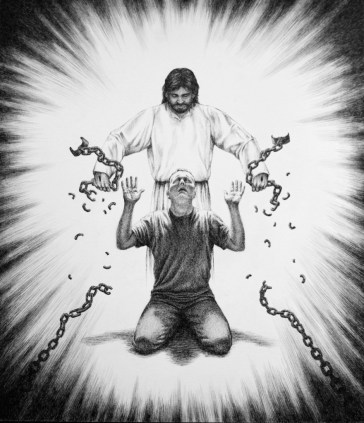
Set-Free     Have you ever wondered just why Jesus came to earth, especially at this time of the year when the world is thinking about Him? Consider for a moment what Jesus already knew before He ever left heaven. He knew that men would seek to kill Him as a toddler (Mat. 2:16). He knew that He would not be received by His own people (John 1:10-11). He knew that He would be rejected by men (Isaiah 53:3-5). He knew that He would be put to death on the cross, not for any wrong that He had done, but for the sins of mankind (Isaiah 53:9; 2 Pet. 2:22-25). And, yet, He came anyway. Why?

     Jesus left the beauties of heaven to come to earth below for one main reason. He came because He loves us all. A very popular scripture tells us that God loved us so much that He gave us His one and only unique Son, so that we might believe in Him, obey Him, and have everlasting life (John 3:16)! Because He loves us, He wants for all of mankind to be saved. The Lord is “not willing that any should perish but that all should come to repentance” (2 Peter 3:9b, NKJV). While we were yet sinners and undesirable, He came and died for us (Romans 5:8).

     Thereto is another part of the reason that Jesus came to earth. We are sinners. As human beings no matter how hard we try, we are not able to be perfect in obedience to God’s word. In Romans 3:23 we read, “for all have sinned and fall short of the glory of God.” Farther along we read, “For the wages of sin is death” (Romans 6:23a). Our sins bring us death, because they separate us from God (Isaiah 59:1-2). Since we all have sinned and separated ourselves from God, and since the just payment of our sins is death, Jesus came to take that penalty away and to reconcile us to back to God. Jesus came so that we might live.

     All Jesus asks for in return is that we believe in Him and obey Him. That is all He wants in return for His great sacrifice. If we claim to love Him, this we will do. Jesus said, “If you love Me, keep My commandments” (John 14:15).

Remember Me

 remember me     In William Shakespeare’s Hamlet, the title character has suspicions about his uncle regarding his father’s death. Those suspicions are confirmed when Hamlet speaks with his father’s ghost. The ghost admonishes Hamlet to action in his final words to his son by saying, “Remember me.”

     Although not in the form of a ghost, Jesus asks us to remember Him in one of His last acts before going to the cross. As He was gathered in that upper room with His twelve apostles, Jesus instituted the Lord’s Supper. He took from the unleavened bread and the fruit of the vine and He instructed them to eat and drink (Matthew 26:26-28). In so doing, they were to remember His sacrifice for their sins and the sins of all mankind. Jesus told them to “do this in remembrance of me” (Luke 22:19b NKJV).

     Later in his writing to the church in Corinth, Paul would repeat this admonition to remember the Lord by partaking in the Lord’s Supper. “For as often as you eat this bread and drink this cup, you proclaim the Lord’s death till He comes” (1 Corinthians 11:26). We also see in Scripture that it was upon the first day of the week, Sunday, that this memorial of the Lord was observed (Acts 20:7).

     There are many things that we may remember and make remembrances regarding them. It may be a special day in history. It may be a group of people who gave their lives in the defense of freedom. It may be in remembering some great leader or president. However, there is no one more deserving of our remembrances than the One who died to give us life. Let us be sure to remember Him each and every Lord’s Day especially. If you would like to know more about the One who died for your sins, come and see what God’s word has to say about Him.

All Gave Some. . . Some Gave All

DSCF4430     Today we remember the brave sacrifice that this nation’s veterans have made over the course of our history.  We honor those who stood in the breaches in the defense of freedom both here in the United States and in other foreign lands around the globe.  Many young men and women made that journey for the cause of our freedom and security, and never returned home again.  While we do not want to take anything away from their dedication to this nation and its freedom, there is an even greater sacrifice that has been made on our behalf, which we must not ever forget.

The pages of the Bible are rich in the telling of the story of Jesus.  Many prophets in the Old Testament alluded to His coming to earth and the mission He was charged with completing. Isaiah 53 is especially compelling, as it gives us a glimpse of the suffering that our Savior was going to go through on our behalf.  It was for the cause of our freedom from sin, that Jesus gave His all for mankind.  Paul tells us that while we were sinners and enemies of God, the Father sent His one and only unique Son to die a cruel death on the cross in our place (Romans 5:6-11).

Even though He was innocent, He allowed Himself to be placed on that cross to die, so that our sins could be removed.  We were the ones who had sinned.  We were the ones who had fallen short of the glory of God (Romans 3:23).  We were the ones who deserved death due to our transgressions, which had taken us away from God (Isaiah 59:1-2; Romans 6:23).  Instead, Jesus stood in the breach between us and our transgressions, and by His stripes, we are healed (Isaiah 53:5).

On this day we remember the sacrifices made by our brave men and women and express our gratitude for their service to our nation.  Let us never forget that we have freedom due to their willingness to act, but also because of the selfless sacrifice of Christ.  He came so that we might have life, and have it more abundantly (John 10:10).  Let us strive to do our part and give Him back our all.

Hammer Away

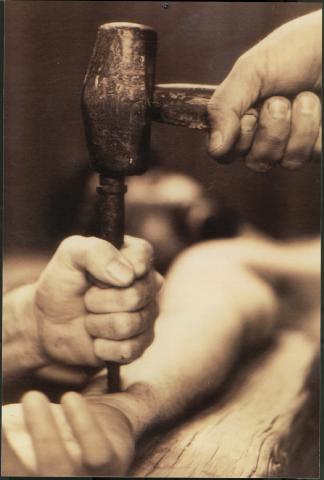
nails     My last remodeling project got me thinking.  As we were going through the process of deconstruction and trying to be careful to limit the amount of scratches and bruises, I began to think about installing the new floor.  You see, when we undertake any project where we are going to be using a hammer and nails it has our full attention.  We don’t want to slip up and hit our fingers or worse yet, pierce our flesh with a nail by mistake.

      Now think about Christ and what He did for us.  He had the power to stop anyone from doing any harm to His body, but He did not exercise that power.  At any time during His mockery of a trial, the scourging of His body, or the nailing of His body on that cross of Cavalry Jesus could have simply said the word ‘stop’ and could have brought His torture to an end.  Concerning His life, Jesus said “No one takes it from Me, but I lay it down of Myself. I have power to lay it down, and I have power to take it again. This command I have received from My Father” (John 10:18 NKJV).

      No one had the power to take Jesus’ life unless He allowed it.  The amazing thing about His love for us in that Jesus allowed those Roman soldiers to take His life.  At a time when we were without hope, at a time when we were still sinners, Christ died for our sins (Romans 5:8).  We work hard to make sure that we don’t slip and allow a nail to poke us in the hand by mistake, but Jesus allowed them to drive large nails through His flesh on purpose.  It is hard to comprehend just what Jesus suffered on our behalf.  So then, are we allowing that sacrifice to have an impact on how we live our lives?

Obedience Trumps Sacrifice

Image          Many times we may come up with our own ideas about what we think would be a good sacrifice to make for God.  It may be that we want to build a great cathedral.  Perhaps we think that giving up something that we like to eat for a certain time period would be a good sacrifice to make for God.  Is this what God wants us to do?  Does He want us to try to figure out what to do on our own?

            In the Old Testament we have an account about King Saul that gives us some insight into this question (1 Samuel 15:1-31).  In this narrative, Saul is returning from defeating the Amalekites, and he and the people have planned to make a sacrifice to the Lord.  For this reason they have not destroyed the best of the sheep and oxen, but have instead brought them back with them (vv. 9, 15).  As Saul encounters Samuel along the way, he is very happy with himself for coming up with this grand idea.  However, God is not pleased with Saul.  Samuel points out to him that he has not followed the commandment of God.  Saul was commanded to destroy everything that the Amalekites had (v. 3).  They were not supposed to bring anything back with them.  Yet Saul has not carried out this command given to him by God, and God is not pleased.  Samuel instructs Saul that God does not delight in sacrifices as He does in obedience, for it is better to obey than to make sacrifice (v. 22).

            We should heed the words of the prophet as well and realize that what God wants from us more than anything is our obedience to His word.  We can say that we believe in God and then go our own way and not obey His commands.  However, if we do not obey, then we do not truly believe.  No matter what sacrifice we may think is appropriate for God, this account clearly shows that obedience to God trumps what we think we can sacrifice for Him.