 When things go wrong it seems that the one thing we never run short of is blame. Just take the Cleveland Browns, for instance. When things go wrong in Cleveland, as they often do, everyone looks for who is to blame for this year’s fiasco. From the ownership, to the general manager, to the head coach, to the assistants, to whomever played the most games at quarterback that year there is always plenty of blame to go around.
How is it with us when things do not go as planned? When we fall short of the mark, or we do the wrong thing, are we also playing the blame game? The blame game is nothing new. Indeed we do not have to read much in the Bible before seeing the “it’s not my fault” principle play out. In Genesis 3 Adam is hiding from God in the garden, because he has eaten from the forbidden fruit and realizes that he is naked (Genesis 3:8-11). God asks, “Have you eaten from the tree of which I commanded you that you should not eat?” (Genesis 3:11b, NKJV). Notice that Adam first blames Eve for his sin. “The woman whom You gave to be with me, she gave me of the tree, and I ate” (Genesis 3:12). Adam also accuses God, since Eve is the woman whom God gave to him.
Instead Adam should have realized the need to take responsibility for his actions. The same is true with us today. When we sin it is not the fault of someone else who “made us do it.” The Devil does not make us do it, as Flip Wilson used to humorously state. Nor can we blame God for our sin. “Let no one say when he is tempted, ‘I am tempted by God’; for God cannot be tempted by evil, nor does He Himself tempt anyone. But each one is tempted when he is drawn away by his own desires and enticed” (James 1:13-14). What causes us to sin is the same thing that has caused mankind to sin throughout all of history. It is our own desires that lead us to sin. It is “the lust of the flesh, the lust of the eyes, and the pride of life,” in our own hearts which leads us astray (1 John 2:16). Let us look to ourselves and take responsibility for our actions. Let us confess our sins and be forgiven of them instead of playing the blame game (1 John 1:9).
 I recently came across a news story out of Thailand about a branch of their national airline. Thai Smile Airways had issued a statement that passengers could purchase an additional ticket for their Luk Thep dolls. The doll owners believe that the dolls have supernatural powers, and that they are inhabited with the angels of children who have passed from this life. Dolls with tickets would need to buckle up before takeoff and landing, and would be served snacks and drinks in flight. Owners have been known to pamper the doll with designer clothing and expensive jewelry, so they may receive a better blessing from the dolls, and one buffet restaurant in Bankok caters to the Luk Thep, or Child Angel, dolls (
 According to horoscope.com for a certain day, my outlook says, “A close friend or your partner could propose an impromptu trip and you might decide to go. You’re restless for adventure. . .” Many people may read that and become excited and think that they are going on a grand adventure! However, do the stars actually know anything about my destiny for today?
 There is a song that we sing in our assemblies that speaks of being resolved no longer to linger, charmed by the world’s delight. Instead, the song says that I will hasten to Him. It is a song about being resolute in leaving the world’s charms behind and pressing on to be with the Lord. As we look out upon another year ending and a new one just beginning, what resolutions are we making for the New Year? What are we leaving behind in 2015, and what are we pressing on towards?
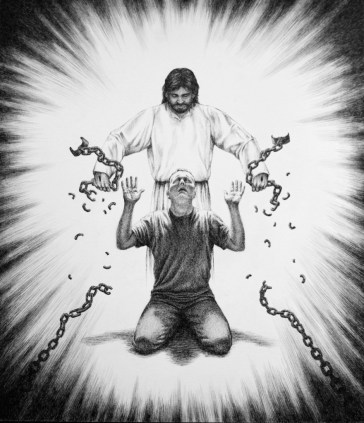 Have you ever wondered just why Jesus came to earth, especially at this time of the year when the world is thinking about Him? Consider for a moment what Jesus already knew before He ever left heaven. He knew that men would seek to kill Him as a toddler (Mat. 2:16). He knew that He would not be received by His own people (John 1:10-11). He knew that He would be rejected by men (Isaiah 53:3-5). He knew that He would be put to death on the cross, not for any wrong that He had done, but for the sins of mankind (Isaiah 53:9; 2 Pet. 2:22-25). And, yet, He came anyway. Why?
 In Charles Dickens’ novel, A Tale of Two Cities, there comes a point where one of the main characters, Charles Darnay, is arrested by the mob during the French Revolution and is sentenced to death. Because of the love that he has for Charles’ wife, Lucie, another character, Sydney Carton, takes Darnay’s place at the guillotine instead. As Carton goes to his death, he utters the most famous line of the novel, “It is a far, far better thing that I do, than I have ever done; it is a far, far better rest that I go to than I have ever known.”
 Modern science and evolutionary theory would have us believe that mankind is nothing more than another type of animal. The necessary conclusion of a “Big Bang” and an evolution of the species is that man is not special, we are nothing more than a happy accident, and thus man does not have an eternal soul. When those of us who have a different worldview consider this issue, we believe in the pages of scripture, which tell us that God made man in His image, that mankind is special and is above the animal kingdom, and that we have an eternal soul (Genesis 1:26-27). However, we often think of the soul as just another physical part of the body, like our heart or our mind.
 In the twelfth year of the reign of King Ahasuerus of Persia, Haman, the king’s right hand man, issued a decree that in eleven months all of the Jews within the Persian Empire were to be executed. Haman was looking to wipe out the Jews because Mordecai, a Jew living in the Persian capital of Shushan, refused to bow down to him. The decree was sealed with the king’s signet ring, which he had given to Haman. This meant that the decree carried the authority of the king, and under Persian law it could not be rescinded (Esther 3:7-12).
