God’s Path to Salvation – Step Five – Be Baptized

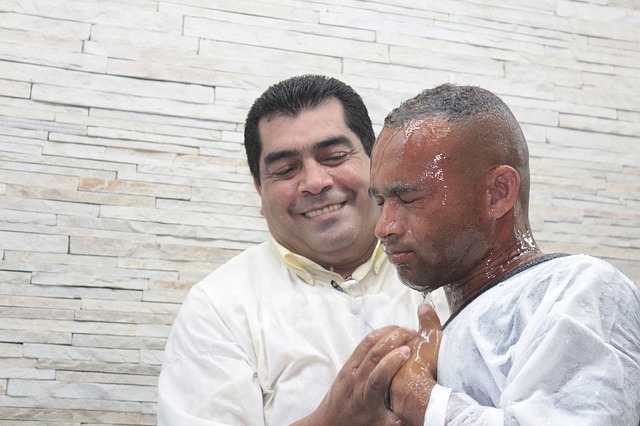
baptism     After hearing and believing the Word, if we are willing to submit to God by confessing our allegiance to Christ and repent of the things we are doing that are wrong, we can become a child of God by being baptized for the remission of our sins.  This step in God’s path to salvation seems to be the most misunderstood and most debated of all of what God requires of us.  Yet, it is a simple step, which the pages of scripture call us to do.  Jesus commands baptism.  The apostles commanded baptism.  Paul was instructed to be baptized.  All of those who converted to Christianity that we can read about in the book of Acts were baptized as part of their conversion.  If you do not believe me, see what God’s Word says about the subject!

     As Jesus was bidding His disciples farewell just before ascending into heaven, He gave them His final instructions.  “And He said to them, ‘Go into all the world and preach the gospel to every creature.  He who believes and is baptized will be saved; but he who does not believe will be condemned’” (Mark 16:15-16NKJV).  Notice here that Jesus states that the one who is a believer and has been baptized will be saved.  It is the same as saying, he who has a ticket and gets into line will be admitted to the game.  We have to have the ticket first in order to get into the game.  If we do not have a ticket, there is no sense in getting into line.  Thus, we have to believe before we are baptized.  If we do not believe, then baptism alone will not affect us.  Additionally, it does us absolutely no good to have a ticket for the game, but to never get into line to enter the building.  Just buying our ticket does not grant us admittance.  Likewise, in order to be saved one must believe and be baptized.

     In Matthew’s recording of the great commission, he writes that Jesus told them to make disciples from all of the nations (Matthew 28:19).  How is it that they were to make disciples?  Jesus tells them how.  He said that they were to baptize them in the name of the Father, Son, and Holy Spirit, and to teach them to observe all of Christ’s commandments (Matthew 28:19-20).  That is how disciples are made.  If you have not been baptized, you are not a disciple (follower) of Jesus Christ.

     It is the act of baptism that washes away our sins.  God did His part in sending His one and only unique Son to die on our behalf, so that our sins might be covered.  Jesus died so that we could be cleansed, sanctified, made holy, and set apart (Romans 5:6-11).  But we also have to do our part in accepting that grace of God.  It is not enough for us to receive a great prize notification, and say that we are rich.  We must claim that prize in order for it to have the intended effect.  It is the act of baptism that puts us in contact with the blood of Christ.  The water has no magical properties, but the act of obedience to what the Lord commanded means that His blood cleanses us from sin.  Paul wrote to the church in Rome, “. . . do you not know that as many of us as were baptized into Christ Jesus were baptized into His death?  Therefore we were buried with Him through baptism into death, that just as Christ was raised from the dead by the glory of the Father, even so we also should walk in newness of life” (Romans 6:3-4).  Being buried with Him in the likeness of His death signifies how we come in contact with the blood He shed, so that our sins can be covered.  Being compared to a burial also tells us of the method of baptism.  It is an immersion, a complete covering.  Otherwise, it is not a burial.

     Peter said that baptism was the act that removes our sins when he preached to the crowd on the day of Pentecost.  On that day the doors of the church were opened for the first time.  Peter explained that those Jews in Jerusalem had been responsible for rejecting Christ and having Him crucified.  They were responsible for His death.  Imagine how they must have felt when Peter showed them that they had put the one and only Son of God to death!  This news pricked them in their hearts.  They were convicted by the word.  They were convinced that they had done wrong.  They wanted to know what they could do to get out of such a terrible predicament (Acts 2:22-37).  “Then Peter said to them, ‘Repent, and let every one of you be baptized in the name of Jesus Christ for the remission of sins; and you shall receive the gift of the Holy Spirit’” (Acts 2:38).  Notice what Peter did not tell them to do.  He did not say to just accept Jesus in your heart and all would be well.  He did not say to repeat a “sinners prayer,” which is not found in Scripture, in order to be saved.  He told them to repent and be baptized.  One is no good without the other.  They were to be baptized for the remission of sins.  Since baptism is the way to remit our sins, if we are not baptized our sins are not remitted.  Later Peter would write that baptism now saves us (1 Peter 3:21).

     One last example to consider is the conversion of Paul.  Paul was a persecutor of the church.  He did not believe in Jesus.  As he was on the way to Damascus to round up more Christians for trial and execution, he saw a bright light and heard the voice of Christ.  Surely that would be enough to save Paul, right?  Notice what Paul was told to do by Jesus.  “Arise and go into the city, and you will be told what you must do” (Acts 9:6b).  So Paul went into Damascus.  There he was told what he must do in order to be saved.  When Ananias came to him, Paul had been praying and fasting for three days (Acts 9:9).  Ananias said to Paul, “And now why are you waiting? Arise and be baptized, and wash away your sins, calling on the name of the Lord” (Acts 22:16).

     Notice that Paul was not saved by seeing Jesus.  He was not saved by speaking to Jesus.  He was not saved by praying and fasting for three days.  If he had been, then why would Ananias have to tell him to be baptized to wash away his sins?  If he had already been saved prior to baptism, there would be no sins that still needed to be washed away.  Notice also that Ananias tells Paul how to call upon the name of the Lord.  You may recall from step one of God’s path to salvation that in Paul’s writing to the Romans in chapter 10 of that letter, Paul told them that those who are saved are those who call upon the name of the Lord.  How do we call upon the name of the Lord?  We do so by obeying Him.  Ananias told Paul that baptism is how we wash away our sins, and how we call upon the name of the Lord.

     The Bible tells us that all of our spiritual blessings are to be found in Christ Jesus (Ephesians 1:3).  Those who are in Christ are no longer condemned (Romans 8:1).  Those who are in Christ are new creatures, having been born again (2 Corinthians 5:17).  Salvation is only to be found in Christ (2 Timothy 2:10).  In Christ, we can have eternal life (1 John 5:11).  So how do we get in Christ in order to receive all of these blessings?  We get in Christ by being baptized into Christ.  “For you are all sons of God through faith in Christ Jesus.  For as many of you as were baptized into Christ have put on Christ” (Galatians 3:26-27, emphasis added).  We must be in Christ to receive the blessings.  We get in Christ by obeying what He has told us to do.  For that, He commanded us to be baptized.

God’s Path to Salvation – Step Four – Repent

14130441997_a4c5a31a2d_o     The next step in God’s path to salvation is to repent of the things that we have done, or are doing, which are not in accordance with God’s word.  Jesus Himself taught that repentance was necessary when He taught His disciples about those Galileans who were killed by Pilate, or about those upon whom the tower of Siloam had fallen upon.  He told them that unless they repented they would all likewise perish (Luke 13:3, 5).

     Similarly, Paul stood upon Mars’ Hill in Athens and preached to those who were listening about the “unknown” God.  In that address, Paul stated that repentance was necessary for salvation.  Regarding their past ignorance of God’s will he told them, “Truly, these times of ignorance God overlooked, but now commands all men everywhere to repent, because He has appointed a day on which He will judge the world in righteousness by the Man whom He has ordained. He has given assurance of this to all by raising Him from the dead” (Acts 17:30-31).  Notice that God calls upon all men, all of mankind to repent.  Notice also that He calls upon all men everywhere.  That means that no one is exempt from the command to repent.

     Later, Paul would tell young Timothy that God wants all men to come to a knowledge of the truth and to be saved (1 Timothy 2:4)  Additionally, Peter explains that God is not willing for anyone to perish spiritually.  He wishes for all men, again that is all of mankind, to repent of what they have done wrong.  Peter writes, “The Lord is not slack concerning His promise, as some count slackness, but is longsuffering toward us, not willing that any should perish but that all should come to repentance” (2 Peter 3:9).  Because it has been almost 2,000 years since the sacrificial death of Jesus upon the cross, men are likely to wonder about the second coming.  It is God who is holding off on the end of the world, because He does not want anyone to perish.  He wants all men everywhere to come to repentance and be obedient to His will.

     Therefore, we need to repent of our sins in order to lay hold of eternal life, but just what is involved in that repentance?  Is it just saying that I am sorry for what I have done?  Is it just saying that I am sorry that I got caught doing something wrong, or is there more to it than that?  We must not be misled into thinking that repentance is just a feeling of momentary sorrow with no change in our actions.  There is much more to repentance than just that feeling of sorrow.  Repentance means that we make a change in our life.  We do not just feel sorry for what we have done, but if we are sinning against God then we change our lifestyle to reflect His wishes, His commands, His will.  Paul explains this difference in writing to the church at Corinth:

Now I rejoice, not that you were made sorry, but that your sorrow led to repentance. For you were made sorry in a godly manner, that you might suffer loss from us in nothing.  For godly sorrow produces repentance leading to salvation, not to be regretted; but the sorrow of the world produces death.  For observe this very thing, that you sorrowed in a godly manner: What diligence it produced in you, what clearing of yourselves, what indignation, what fear, what vehement desire, what zeal, what vindication! In all things you proved yourselves to be clear in this matter (2 Corinthians 7:9-11)

Notice that Paul is not rejoicing in their sorrow, but in the fact that their godly sorrow produced repentance, a change of direction.

     It is our godly sorrow that will lead us to repentance.  Our repentance, our change of mind, our change of direction will then lead us to God and His salvation.  It is not like the sorrow of the world whereby we might just be sorry that we were caught in wrongdoing.  Let us all put our sins behind us, and throw off that weight so that we may run our race unencumbered by sin (Hebrews 12:1).  Let us learn to repent of what we do that does not match God’s will, so that we can have that hope of eternal salvation when our life here is done!

God’s Path to Salvation – Step Three – Confess

IMG_20140614_134736708_HDR     Once we have heard God’s word and have come to believe it to be true, we have to be willing to make a good confession of what we believe.  Just as Paul instructed Timothy to, “Fight the good fight of faith, lay hold on eternal life, to which you were also called and have confessed the good confession in the presence of many witnesses” (1 Timothy 6:12 NKJV), we too are to make a public confession of our faith in Jesus Christ.

     In this confession we are letting others know of our choice to follow Jesus and be obedient to His will.  So then, in our confession, we are stating our belief, but we are also pledging allegiance to God.  There is much more to it than just stating our allegiance, as well.  If all our confession was about just saying that we believe in the existence of God and Jesus as His Son, then all we have done is pay lip service to God.  Satan and the demons know that there is one God, and they know that Jesus Christ is His one and only unique Son.  This is demonstrated in Jesus’ casting out of the demons in Matthew 8.  They called Him by name.  They knew who He was.  They recognized His authority.  Yet they are not among the saved, because they refuse to submit to God.  James wrote, “You believe that there is one God. You do well. Even the demons believe—and tremble!  But do you want to know, O foolish man, that faith without works is dead?(James 2:19-20).

     Therefore, when we confess that we believe in Christ, we are also confessing that we will do all that we can to be faithful and loyal to Him.  It means that we are confessing that we will show by our lives that we are followers of Him.  It means that we are pledging ourselves to Him as a living sacrifice, not being conformed to the world, but trying our best to walk in step with our Savior (Romans 12:1-2).  This style of confession is necessary for us to receive the gift of salvation.  God offers His grace to us, and that grace is free.  There is nothing we can do to pay for it or to earn it somehow, so that God owes it to us.  But we must be willing to lay hold of that salvation that He provides for us.  Confessing Him is part of that.

     Jesus said that whoever would confess Him before men, He would confess before the Heavenly Father (Matthew 10:32).  That is a great deal!  We ought to take hold of that quick, fast, and in a hurry.  You will not find a better deal this side of eternity!  Paul wrote to the Romans, “that if you confess with your mouth the Lord Jesus and believe in your heart that God has raised Him from the dead, you will be saved.  For with the heart one believes unto righteousness, and with the mouth confession is made unto salvation” (Romans 10:9-10).

     Our belief needs to move us to action.  Mental acquiescence of God’s existence only puts us on a level with the demons.  We must act in submission to His will and do what He says to do in order to have salvation.  God says to confess Christ with our mouths, by our actions, and through our lives.  If we do so, we are well on our way to heaven!

God’s Path to Salvation – Step Two – Believe

IMG_20140614_134903975_HDR     Once we have heard the word of God, the next step on God’s path to salvation is to believe the word of God and have faith.  Going back to Paul’s statement to the Romans, faith is to come by hearing the word of God (Romans 10:17).  So we do not hear the word of God just to be hearers of it, but the word of God is to build up our faith in God.  James says that we are to be doers of the word, and not just hearers only (James 1:22).  Therefore, we need to do something about what we hear.  Part of that is having an active faith.

     Notice also that our faith is to be based upon what we hear in God’s word.  It is not a blind faith, which is based upon nothing more than our feelings and emotions.  Faith or belief which is based upon nothing (no evidence) is not really faith, but is irrational.  God has given us a very good definition of faith within His Holy Word.  Consider that, “Now faith is the substance of things hoped for, the evidence of things not seen” (Hebrews 11:1).  Faith has substance.  There is evidence for faith.  John wrote in his gospel that there were many things that Jesus did which he did not record, but what was recorded was done in order that we might read, hear, and believe (John 20:30-31).  In the Roman letter Paul reminds us that there is evidence for God, even His eternal power and Godhead, which has been manifested to all through His creation, so that man is without excuse if he chooses to not believe in God (Romans 1:18-23).

     Additionally, God’s word is clear that we must believe in God in order to come to Him and be saved.  “But without faith it is impossible to please Him, for he who comes to God must believe that He is, and that He is a rewarder of those who diligently seek Him” (Hebrews 11:6).  So we must have faith in order to please Him.  We must believe that God is in order to come to Him, or else why would we?  Who would strive to approach a god that they did not believe in?  We must understand that in order to be rewarded by God with salvation, we must diligently seek Him.  Jesus said that the one who believes and is baptized shall be saved, but the one who does not believe will be condemned (Mark 16:15-16).

     We must have faith in Him.  Faith in Him is much more than believing that He exists.  It requires that we do not just “believe that” He is, but that we “believe in” His promises.  He has promised eternal life to those who will do His will and keep His commandments (Matthew 7:21; John 14:15, 21; 15:10).  John, the apostle whom Jesus loved, wrote the following by inspiration:

Whoever believes that Jesus is the Christ is born of God, and everyone who loves Him who begot also loves him who is begotten of Him.  By this we know that we love the children of God, when we love God and keep His commandments.  For this is the love of God, that we keep His commandments. And His commandments are not burdensome.  For whatever is born of God overcomes the world. And this is the victory that has overcome the world—our faith.  Who is he who overcomes the world, but he who believes that Jesus is the Son of God?  (1 John 5:1-5).

In order to overcome the world and be a child of God and have that salvation that He freely offers to mankind, we must believe in God (have faith in Him and His promises), and love Him by keeping His commandments.

God’s Path to Salvation – Step One — HEAR

John 1717 [widescreen]It is important for us to realize that God has a path to salvation for mankind.  It is not my path to salvation.  It is not some board or council’s path to salvation.  It is not the path to salvation of some college of titled officials.  It is not the entrance requirements for some church or religious institution.  It is God’s path, and as such He calls all men to come out of the world and be a part of His ekklesia, His church, those who have been ‘called out’ of the world, His own special people (1 Peter 2:9).

For the first step in God’s Path, Hearing God’s Word, click here to go to the lesson.

A Desired Result

WaxOnWaxOff     In the 1984 movie The Karate Kid, a young boy who is tired of being bullied comes to Mr. Miyagi to learn karate.  While training him, Mr. Miyagi is shown to have some strange teaching methods.  He has Daniel wash and wax his vehicles, sand the floor of his deck, and paint his fence.  When Daniel doubts that he has learned anything useful, Mr. Miyagi shows him what the motions that his muscles have memorized can do to help him defend himself.

     In the Bible we can read of a similar situation.  Naaman, a commander of the army of Syria, came to Israel to seek out the prophet Elisha in order to be healed of his leprosy (2 Kings 5:1-8).  As he approached Elisha’s house he was met by a messenger who had come from Elisha.  The messenger told Naaman that in order to be cured of his leprosy he must dip in the Jordan seven times (2 Kings 5:9-10).

     Naaman was furious.  He thought that Elisha would wave his hand all over the place and make a great show in calling on the name of God.  Instead, Elisha has sent his word by a messenger.  To top it all off, Naaman was told to dip in the dirty Jordan river, not the much better rivers back home in Syria (2 Kings 5:11-12).  Nevertheless, Naaman did what the prophet instructed him to do, and his leprosy was healed (2 Kings 5:13-14).  Like Daniel with Mr. Miyagi, Naaman learned that simple obedience produced a desired result.

     How is it with us?  Do we expect to be tapped on the shoulder by God and told what to do?  At one time God spoke with man either directly or through the prophets, but now He speaks to us by His Son (Hebrews 1:1-2).  Jesus’ message for salvation is simple, “he who believes and is baptized will be saved” (Mark 16:16a NKJV).  We may be looking for a grander scheme, but why not simply obey what God has said to do.  After all, it worked out pretty well for Naaman!

Love Without Labels

Couple_01     This week we are being told through a public service announcement that love has no labels.  That sounds pleasant, does it not?  Who could disagree that love has no labels?  However, just what is meant by this announcement?  What is being cast upon us is yet another attempt to show that homosexuality is normal and okay.

In an unrelated story, Dr. Ben Carson stated his belief that people choose to be homosexuals.  They are not born that way.  Very shortly after answering a question that exposed his belief, Carson took it back.  He back peddled and tried to explain his answer in a way that would be more acceptable to those of a gay persuasion.  The real question is, are these events really unrelated?

There is and has been a tremendous push in our country to justify, normalize, and force everyone to accept homosexuality as a viable, wholesome, alternative lifestyle.  Anyone who disagrees is instantly labeled as homophobic, hateful, or a bigot.  Let us just take a moment to think about the tactics from a logical standpoint for a moment.

Those of us who disagree with said lifestyle, are no longer allowed to express our opinion without fear of retribution, harassment, loss of employment (if employed within the media), and other labeling by the crowd that is telling us that love has no labels.  It cannot be about tolerance, for tolerance would demand that I can express my opinion as equally as they can theirs.  It is all about acceptance.  We are being forced to accept their opinion and say nothing about it.

I do not say this to be mean spirited, unloving, or otherwise prejudiced against a segment of society.  I merely mean to express another viewpoint with regards to this issue, and that is the viewpoint that God has written for our learning in the Bible.  By expressing what the Bible has to say about the issue, it is not my intention to “force my religion” down anyone’s throat.  God does not operate that way.  He merely tells us what is right, what is righteous, what is wholesome, and what is not.  Then it is up to us to decide if we will follow Him, or go our own way.  It is our choice, Dr. Carson.

Nowhere does God explain this better than in Paul’s letter to the Romans.  “For the wrath of God is revealed from heaven against all ungodliness and unrighteousness of men, who suppress the truth in unrighteousness, because what may be known of God is manifest in them, for God has shown it to them” (Romans 1:18-19 NKJV).  When mankind suppresses the truth, because they do not like it, that is called unrighteous and ungodly.  The creation of man itself is proof that there is a God.  There is no way that the complicated systems that exist within human life could have come about by chance.  Thus the evidence is within man, such that we are without excuse if we fail to believe that there is a God (Romans 1:20).

However, there are those who have not retained God in their knowledge.  They have made a conscious choice to walk away from God.  They do not glorify Him, nor are they thankful.  Instead, they profess to be wise when really they are being foolish for ignoring God (Romans 1:21-22).  Because they have given up on God and walked away from Him, He will also give them up.  They will not be considered to be His children anymore, while they are acting disobedient.

Therefore God also gave them up to uncleanness, in the lusts of their hearts, to dishonor their bodies among themselves. . . For this reason God gave them up to vile passions. For even their women exchanged the natural use for what is against nature.  Likewise also the men, leaving the natural use of the woman, burned in their lust for one another, men with men committing what is shameful, and receiving in themselves the penalty of their error which was due (Romans 1:24, 26-7).

Notice what God calls it when women exchange the natural use of their body to be with other women.  Notice what God says about men who burn in their lust for other men.  He says that they dishonor their bodies.  He calls their passions vile.  He says that their actions are shameful and deserving the penalty of their error.  It sounds like God has put “labels” on their “love.”

The real issue is a misunderstanding of love.  Men are to have brotherly love for one another.  This is the Greek word philos.  It is not the same as the love between a man and his wife that includes the sexual relationship.  This kind of love is eros (where we get the word erotic from).  Mankind has blurred the lines between the kind of love that we are to show toward one another, and the kind of love that is reserved for a married man and his wife.  So when people say, “well what is wrong with loving one another,” they are misunderstanding the difference between brotherly love and lust.

So why make such a big deal about this issue?  What harm is there in accepting what God says is vile, ungodly, unrighteous, and against nature?  Well, just notice what Paul goes on to write at the end of Romans 1:

(They) being filled with all unrighteousness, sexual immorality, wickedness, covetousness, maliciousness; full of envy, murder, strife, deceit, evil-mindedness; they are whisperers, backbiters, haters of God, violent, proud, boasters, inventors of evil things, disobedient to parents, undiscerning, untrustworthy, unloving, unforgiving, unmerciful; who, knowing the righteous judgment of God, that those who practice such things are deserving of death, not only do the same but also approve of those who practice them (Romans 1:29-32).

Not only does God disapprove of the homosexual lifestyle, His judgment is also going to be against those who approve of their behavior.  God says if you are okay with things that He calls evil, then you are deserving of spiritual death just the same as those who are practicing such.  That looks like God is placing many labels on their “love,” and none of those labels are good.

One last point with regards to this issue needs to be made.  The argument that homosexuals are that way because that is how God made them cannot be true if the Bible is to be believed.  Notice that God states the penalty for those who practice such behavior quite clearly in Romans 1.  If God were to make people that way, with that persuasion, then He would be making people to sin and be lost.  That is not God’s nature.  God does not tempt us to do evil.  We are tempted when we are led away by our own desires.  That desire then leads us to sin.  It is our own doing (James 1:13-15).  Indeed, God does not desire that anyone be lost.  He wants for all men to come to a knowledge of the truth (1 Timothy 2:4), and then to repent and follow Him (2 Peter 3:9).  People choose to practice what they practice.  They are not made to sin by God without a choice.

Furthermore, notice what Paul writes to the church in Corinth:

Do you not know that the unrighteous will not inherit the kingdom of God? Do not be deceived. Neither fornicators, nor idolaters, nor adulterers, nor homosexuals, nor sodomites, nor thieves, nor covetous, nor drunkards, nor revilers, nor extortioners will inherit the kingdom of God.  And such were some of you. But you were washed, but you were sanctified, but you were justified in the name of the Lord Jesus and by the Spirit of our God (1 Corinthians 6:9-11 emphasis added).

There were some who were in the church in Corinth who had formerly been homosexuals.  Paul says that they were washed, they were changed, they made a conscious decision to follow God rather than their own lusts.

There is no need to be lost in sin when we can repent, change our sinful lifestyle, and become a child of God again.  This not only applies to the sin of homosexuality, but with any and all sin.  God does not state that one sin is any worse than any other, and neither should we.  Let us only apply the labels that God applies, and strive to walk in His ways each day.
Shoot the Messenger

Lewis_Hine,_A_typical_bike_messenger,_Birmingham,_Alabama,_1914     How do we react when we are given bad news?  Do we want to take it out on the one who is bringing us the report?  Many times, those who bring bad news are ostracized because of the message they carry.  We see that this was the case with Israel and the prophets.

     One such case occurs in 1 Kings 18 when Elijah comes looking for Ahab, the king of Israel, after hiding from him at God’s direction.  Ahab had been looking high and low for Elijah because of the drought in the land (Elijah had told Ahab that it would not rain again for several years 1 Kings 17:1).  When Ahab’s servant Obadiah comes into contact with Elijah, he is afraid to go back and tell Ahab that Elijah is here, for fear that Elijah will be called away and Ahab will kill him (1 Kings 18:9, 12, 14).  Obadiah fears that Ahab will shoot the messenger.

     Once Ahab finally sees Elijah, he greets him by saying “Is that you, O troubler of Israel?” (1 Kings 18:17 NKJV).  Ahab is not happy to see Elijah.  Later Ahab will complain to Jehoshaphat with regards to Macaiah saying, “I hate him, because he never prophesies good concerning me, but always evil” (2 Chron. 18:7).  Ahab was not thrilled with any of the prophets, because they did not hesitate to tell him that what he was doing was wrong.  Ahab had a tendency to shoot the messenger when it came to these men of God bringing him the word of the Lord.

     How is it today?  Are people willing to hear the word of God with an open heart, or are they only concerned with shooting the messenger because they don’t like the message?  We as Christians have a duty to spread the Good News about the death, burial, and resurrection of Christ and the hope of eternal life that comes from that blessed event (Mat. 28:19-20; Mark 16:15-16).  There is a need for us to tell the truth of God’s word just as there was in the time of Ahab.  We should be like Elijah and Macaiah and speak for God, even if others wish to shoot the messenger.

The Choice is Ours

Fork-in-The-Road     Every day we get to make choices.  We make choices about what we eat, where we go, what we see, and what we do.  Many of the choices we make seem to only be for that moment, and then they are gone.  Others affect us for the rest of our lives.

     Consider the choice that was put before the Israelites just before they were to go into the Promised Land.  God through Moses told the people that they had a choice before them.  They could choose life and good, or they could choose death and evil (Deuteronomy 30:15).  God was not going to force them to be good or to choose the right path.  The choice was theirs.

     If they chose to do what was right, “. . . to love the Lord your God, to walk in His ways, and to keep His commandments, His statutes, and His judgments . . .” (Deuteronomy 30:16 NKJV), then they could stay in the land that was promised to their fathers forever.  However, if they chose to do that which was against God’s commands, and decided to worship other gods, then they would not be allowed to remain in that land (Deuteronomy 30:17-18).  Ultimately we know what choice they made.  They constantly went after other gods, and their idolatry led to them being taken away in the Babylonian captivity.  Thus, although a remnant returned to that land, they broke their part of the covenant relationship with God and lost the Promised Land.

     We equally have a choice before us.  Will we choose to follow God and make it to the Promised Land of heaven, or will we go our own way and lose out?  Jesus said, “I am the way, the truth, and the life. No one comes to the Father except through Me” (John 14:6).  In order to go to God, we must go through Jesus.  The choice is ours.  Our choices have consequences.  Let us therefore choose wisely!

Life Is In The Blood

George Washington     In December 1799 George Washington passed from this life.  He had been out taking care of his property in foul weather and had come down with what would appear to be a cold (sore throat, congestion, etc.).  In an effort to save the former president, his doctors took to opening veins and “bleeding” him, which was believed at the time to be the way to get the illness out of his system.  What the doctors of the time failed to realize is that life is in the blood.

     Man cannot sustain his physical life without blood.  This was well known to the Israelites, or should have been, since God forbade the eating of blood because “life is in the blood. . .” (Leviticus 17:11a NKJV).  Human medicine has come to realize the importance of blood in sustaining life in the years following Washington’s death.  Now, much can be done with transfusions to help stabilize patients who have suffered a loss of blood.

     In looking at man’s spiritual life, it can be seen that our spiritual life is also in the blood.  The Scriptures tell us that we have all sinned (Romans 3:23), and that the wages, the anticipated payment, of sin is spiritual death (Romans 6:23).  We know that this is not in reference to physical death, for we must all be subject to that unless the Lord returns first (Hebrews 9:27).  In order to have spiritual life, an eternity in heaven, we must have our sins covered by the blood of Christ (1 John 1:7; Revelation 1:5).

     We make contact with the blood of Christ when we are buried with Him in the act of baptism (Romans 6:3-4).  In obeying the command of Christ to be baptized (Mark 16:16), we can have our sins washed away (Acts 2:38; 22:16).  It is in our obedience to the words of Scripture, that the blood of Christ is applied to us and we are cleansed from our sins.  Thus, we are able to have spiritual life.  Thus, both our physical life and our spiritual life are in the blood!