Peace and Safety

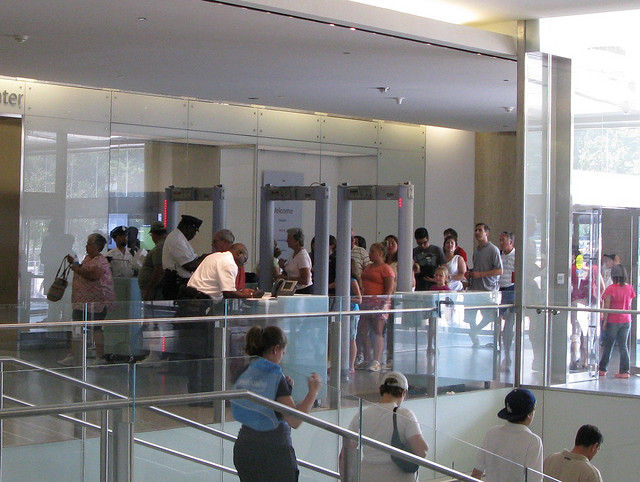
3828960388_ebf3fe4262_z     Last week my family and I traveled to our nation’s capital on vacation.  While we were in D.C., a man jumped the fence and attempted to gain entry to the White House.  It was not me.  However, it made us think about the security measures we did see while in Washington.  At most of the museums and monuments, there were security screenings and metal detectors in an effort to make us all feel safe.

That feeling of safety is something we all crave, especially in our modern world.  News of attacks and planned attacks seem to dominate the news.  And while the extra security measures are necessary to try to prevent further attacks, do they really make us feel safe?  When the security guard is talking to his buddy about last night’s game instead of watching the x-ray monitor, do you really feel safer?

While we may never be at peace or feel that we are completely safe in a physical sense in this world, there is a peace and safety that comes from the Lord.  This peace allows us to pillow our heads at night and sleep, without having to worry about what will come in the night.  As David wrote, “I will both lie down in peace, and sleep; For You alone, O Lord, make me dwell in safety” (Psalm 4:8 NKJV).

If we are in a right relationship with God, if we are in obedience to His will and His word, if we have put our trust in Him, then we can have peace.  We have a peace of mind, even if we don’t live in a world that provides us with much hope of physical safety (John 14:27).  We can have that peace, because we know that if anything happens to this earthly body, our eternal soul will be in the hands of a God who loves us.  If you want that peace too, you can have it by seeking God and obeying what He has told us to do.


God Wants You!


070822-N-0807W-233

I can remember being in school gym class as sides were being chosen for a game of kick ball.  Everyone wanted to be picked first to be on the best team.  No one wanted to be picked last, because if you were last, you were not really picked.  As one of my classmates aptly pointed out, being the last player chosen meant that team ended up with you by default.  They did not choose you.

How comforting it is to know that if we are obedient to God’s word that He has chosen us for salvation.  There is no pecking order, and God has not ended up with us by default, but we were chosen by Him to be His children.  Consider what Peter writes in saying,

“Coming to Him as to a living stone, rejected indeed by men, but chosen by God and precious, you also, as living stones, are being built up a spiritual house, a holy priesthood, to offer up spiritual sacrifices acceptable to God through Jesus Christ. . . But you are a chosen generation, a royal priesthood, a holy nation, His own special people, that you may proclaim the praises of Him who called you out of darkness into His marvelous light” (1 Peter 2:4-5, 9 NKJV).

God has chosen those who will obey Him to be His own special people, a royal priesthood, a chosen generation.  He has chosen us to be His, and He has chosen us for His own special mission.  That mission is to proclaim the praises of the One who has called us out of the darkness and into His marvelous light.

God wants you, but you have to come to Him in simple obedience of His word, as a living stone or living sacrifice (Romans 12:1-2) in order to be accepted by Him.   Are you a member of that chosen generation?  Are you one of His own special people?  Are you a part of that royal priesthood?  If not, why not?

Obedience Trumps Sacrifice

Image          Many times we may come up with our own ideas about what we think would be a good sacrifice to make for God.  It may be that we want to build a great cathedral.  Perhaps we think that giving up something that we like to eat for a certain time period would be a good sacrifice to make for God.  Is this what God wants us to do?  Does He want us to try to figure out what to do on our own?

            In the Old Testament we have an account about King Saul that gives us some insight into this question (1 Samuel 15:1-31).  In this narrative, Saul is returning from defeating the Amalekites, and he and the people have planned to make a sacrifice to the Lord.  For this reason they have not destroyed the best of the sheep and oxen, but have instead brought them back with them (vv. 9, 15).  As Saul encounters Samuel along the way, he is very happy with himself for coming up with this grand idea.  However, God is not pleased with Saul.  Samuel points out to him that he has not followed the commandment of God.  Saul was commanded to destroy everything that the Amalekites had (v. 3).  They were not supposed to bring anything back with them.  Yet Saul has not carried out this command given to him by God, and God is not pleased.  Samuel instructs Saul that God does not delight in sacrifices as He does in obedience, for it is better to obey than to make sacrifice (v. 22).

            We should heed the words of the prophet as well and realize that what God wants from us more than anything is our obedience to His word.  We can say that we believe in God and then go our own way and not obey His commands.  However, if we do not obey, then we do not truly believe.  No matter what sacrifice we may think is appropriate for God, this account clearly shows that obedience to God trumps what we think we can sacrifice for Him.