Isn’t That Convenient

In today’s fast-paced world, convenience has become a significant aspect of our daily lives. The definition of convenience often involves little trouble or effort, and we tend to favor it because it allows us to avoid going out of our way and makes it easier to be lazy. However, convenience is not always beneficial.

While convenience can make our lives easier, it can also lead to negative consequences. For instance, it can cause us to overspend. Imagine needing something that costs $10, but you end up spending $50 to get free shipping, thinking you saved $4.99 in shipping fees. Additionally, convenience can lead to loneliness. With apps that allow us to order food and complete transactions without speaking to anyone, our electronic devices have made things easier but at what cost?

There was a time in the history of Israel when convenience became a significant problem. Solomon’s sins, as mentioned in 1 Kings 11:29-33, led to the division of the kingdom into Israel and Judah. Jeroboam took ten tribes to the North and, in an attempt to make worship easier for his subjects, he built and fortified a new capital city, Shechem, in the tribal area of Ephraim. He was more concerned about maintaining his power than the well-being of his subjects, fearing they would return to the house of David if they went to Jerusalem to offer sacrifices.

Jeroboam’s solution was to make worship easy for his subjects by setting up two golden calves, with one in Bethel and one in Dan. This act was reminiscent of the golden calf incident in Exodus 32. The people, preferring the convenience, accepted this new form of worship. However, this was not the worship the Lord desired. It was in the wrong place, in the wrong manner, with the wrong priests, and directed towards the wrong subject.

Choosing convenience over what God wants can lead to dire consequences. Jeroboam’s actions led to punishment in the days of Josiah, as prophesied in 1 Kings 13:1-2 and fulfilled in 2 Kings 23:15-16. Amos was sent to Israel with a message that they would be led away captive, as mentioned in Amos 7:10-13. If we choose convenience over God’s commands, our worship becomes vain and useless.

God desires what He wants, and it might not always be convenient for us. It may not be a convenient time or place, and there may be other things we would rather be doing. However, convenience does not please the Lord. Our heart and desire must be for Him, and we should want to do what pleases the Lord, even if it requires effort. Choosing convenience over God’s commands can lead to consequences we do not want to face. Instead, we should desire to be with Him in eternity.

Be Ye Doers of the Word

The book of James often mirrors the Sermon on the Mount and offers much in the way of practical applications and Christian living. James 1:22-25, in particular, challenges believers to achieve a faith that goes beyond just hearing.  It is faith marked by action. This section begins with a call to action: “But be doers of the word, and not hearers only, deceiving yourselves” (James 1:22). The difference between hearing and doing is vital. James says that hearing the word without applying it can lead to self-deception. Simply nodding along to sermons or reading Scripture without having it affect our lives creates a false sense of security. One may feel they are in league with God but be mistaken.

In verses 23-24, James uses a well-worn metaphor: hearing the word without doing it is like looking in a mirror, walking away, and forgetting what has just been seen. The mirror symbolizes God’s word, the perfect Law of Liberty, which exposes our spiritual condition. If we fail to act upon this, what results is a lack of spiritual growth.  A mirror doesn’t change us; it only shows us what needs attention.

By contrast, the one who looks into the “perfect law of liberty and continues in it, and is not a forgetful hearer but a doer of the work, this one will be blessed in what he does” (James 1:25). This “law of liberty” is the word of God, to which we must adhere.  Thus, we need to do by applying God’s holy word to our daily lives.  It ought to be the driving force behind who we are and what we choose to do.  If we want to grow closer to Christ, don’t just hear what the Lord has to say, do it!

Once We Are Saved, Are We Always Saved?

            There are a significant number of people in the religious world today who believe that once we are saved from our sins, that we will always be saved.  In other words, once we are saved, we can never be lost again.  Within Calvinism, this doctrine is known as the perseverance of the saints.  To bolster their belief, several passages of scripture are used to ‘prove’ their case.  One such passage reads, “For I am persuaded that neither death nor life, nor angels nor principalities nor powers, nor things present nor things to come, nor height nor depth, nor any other created thing, shall be able to separate us from the love of God which is in Christ Jesus our Lord” (Romans 8:38-39).  Does this passage really teach that once we are saved, we are always saved and can never fall away?

            These two verses of scripture are in a larger context where Paul is explaining to the brethren in Rome that there is nothing that can separate us from the love of God.  God is always going to love us.  We need not think that any tribulation or persecution that we might suffer is evidence that God has stopped loving us (Romans 8:35-37).  None of these things can separate us from God.  Even our great adversary, the Devil, cannot separate us from God, though he will certainly accuse us and try to condemn us.  If we belong to the Lord, then we have Jesus to intercede for us with the Father (Romans 8:31-34).  So, there is no external force that can separate the believer from God.

            But does this mean that we are always saved no matter what?  While no external force can keep us from God, we can.  No one else can pluck us out of the hand of God (John 10:29), but we can lose our salvation if we give it up.  Notice in Hebrews 2:1 that we need to give heed to what Jesus has said so we will not drift away.  Drift away from where?  We cannot drift away from a place we have never been.  The book is written to Hebrew Christians who have been saved.  Why warn them about drifting away if that is an impossibility?  One might say they were never really saved since they have drifted away, but Hebrews 6:4-6 shows someone who has definitely been saved who then falls away.  Peter also speaks of those who were saved who then went back into the world and were lost (2 Peter 2:20-22).  Paul says, “let him who thinks he stands take heed lest he fall” (1 Cor. 10:12). Again, why the warning if we cannot fall from grace?

            The Bible has many examples of those who had lost their salvation.  Judas, who was handpicked by Jesus to be an Apostle fell.  Demas fell, having loved this present world (2 Tim. 4:10).  Alexander and Hymeneus suffered shipwreck regarding their faith (1 Tim. 1:19-20).  You cannot suffer shipwreck if you were never on the boat!  Even Paul, an inspired Apostle, could lose his salvation (1 Cor. 9:27). 

While no one else can take it from us, it is important for us to remain faithful, so that we will not lose our salvation.  For, “how shall we escape if we neglect so great a salvation, which at the first began to be spoken by the Lord, and was confirmed to us by those who heard Him?” (Heb. 2:3).  We will not escape the wrath of God that is to come if we neglect, or count as worthless, the great salvation that God has given to those who obey Him.

All Things That Pertain to Life and Godliness

            Have you ever spent Christmas Eve feverishly trying to assemble that last gift?  Perhaps you waited until the last moment thinking it wouldn’t be a big deal or difficult.  It only required some assembly, after all.  Then you notice that the instructions are not clearly written, and the diagrams are small and ambiguous as to which side of the frame the screws are supposed to be inserted.  Don’t you wish that you had all that pertains to how to put this thing together?

            God’s instructions for us are not like that.  They are neither unclear, nor ambiguous.  Peter tells us that God, through His magnificent ability and divine power, “has given to us all things that pertain to life and godliness, through the knowledge of Him who called us by glory and virtue” (2 Peter 1:3 NKJV).  He has given us all the things that we need in order to know how to live a godly life.  He has left nothing to chance.  He has given us no reason to wonder what it is that He wants.  Through God’s written word, the Bible, mankind can have all the information and instruction necessary to live a life that pleases the Lord.  We can read and understand what God wants us to know (Ephesians 3:3-5).  We can understand the will of the Lord (Ephesians 5:17).  We can have the knowledge of Him and His will so that, “you may walk worthy of the Lord, fully pleasing Him, being fruitful in every good work and increasing in the knowledge of God” (Colossians 1:10). 

            Of course, many choose to ignore the instructions.  Sometimes our pride gets in the way.  I know how to put this thing together.  Hours later, we begin to look for where we laid those instructions.  When all else fails, consult the instructions.  However, it would be better to start with the instructions so that we can arrive at the desired end.  Our desired end ought to be heaven.  Our desired end ought to be having a relationship with our Lord and Savior.  We can say, “I don’t need the instructions, I know what I am doing,” but that path will not lead us to know God as He wants to be known.  He has given us all things for living a godly life in His inspired words.  Let us look to those basic instructions before leaving earth so that we will get to be where we want to go.

I Am Resolved

          There is a song that we sing in our assemblies that speaks of being resolved no longer to linger, charmed by the world’s delight. Instead, the song says that I will hasten to Him. It is a song about being resolute in leaving the world’s charms behind and pressing on to be with the Lord. As we look out upon another year ending and a new one just beginning, what resolutions are we making for the New Year? What are we leaving behind in 2023, and what are we pressing on towards?

     In the Philippian letter, Paul writes, “Brethren, I do not count myself to have apprehended; but one thing I do, forgetting those things which are behind and reaching forward to those things which are ahead, I press toward the goal for the prize of the upward call of God in Christ Jesus” (Phil. 3:13-14). We might look back at last year’s resolutions and see how we did. Perhaps our resolution only lasted a couple of weeks or a month. Maybe we were resolved to lose ten pounds last year, and now we are only fifteen pounds away from our goal. But, forgetting those things that are behind us, let us look forward to the opportunities in the New Year to be resolved to do better.

     In 2024 let us then be resolved to:

   · Lose the weight of sin in our lives (Heb. 12:1)

   · Exercise greater discernment between good and evil (Psalm 34:14)

   · Improve our spiritual health (1 Peter 1:13-16)

   · Help save the souls of those around us (Mat. 28:19-20)

   · Stop making excuses and abound in the work of the Lord (1 Cor. 15:58)

  I am reminded of an old commercial that showed a man at his desk and each year the pile of papers grew higher. Each year he stated that this was the year he was going to hunker down and get something accomplished. Is 2024 the year that we will grow closer to the Lord? Or will 2024 be like every other year? The choice is ours. The next year is ready and waiting. Are we resolved no longer to linger?

God’s Family

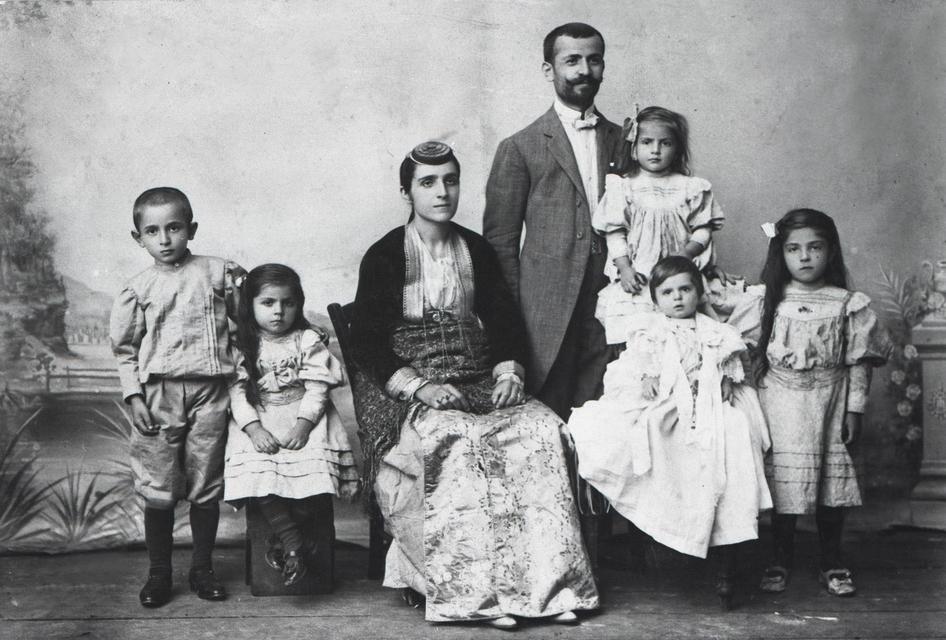
Pontus_Greek_family     If we are like most people, somewhere amongst all of our belongings there is a family photo album or two. From time to time we like to take out that photo album and relive the memory of lost loved ones or special times and events in our life. Maybe we gather around with others in our family and share stories from the past. Family is important and makes us feel like we belong to a group with a common background, common experiences, and a shared heritage. Just imagine for a moment what it would be like if God had a family photo album. Whose pictures would be in that album?

     We see that family was important to Jesus, but maybe not in the way that we think. There was an occasion where Jesus was teaching His disciples, and while He was still speaking to them He was told that his physical mother and brothers were waiting outside to speak with Him (Mark 3:31-2). Then Jesus said, “’Who is My mother, or My brothers?’  And He looked around in a circle at those who sat about Him, and said, ‘Here are My mother and My brothers!  For whoever does the will of God is My brother and My sister and mother’” (Mark 3:33-35 NKJV). Jesus stated that His spiritual family was more important to Him than His physical family.

     If we want to be a part of God’s family, if we want for our pictures to be in His “photo album,” then we need to do what Jesus says to do. Notice He said “whoever does the will of God” is His family. It is important then, that we do the will of God. Compare this to what Jesus said in the Sermon on the Mount, “Not everyone who says to Me, ‘Lord, Lord,’ shall enter the kingdom of heaven, but he who does the will of My Father in heaven” (Matthew 7:21). It is not enough for us to just call Him Lord, we must be willing to do the will of the Father to be in the family of God and to enter into the kingdom of heaven. Have you obeyed God’s will? Is your picture in God’s photo album? We invite you to come and see what God’s word has to say about the will of the Lord, so that all of us can be in God’s family!

Do This in Remembrance of Me

grapes     Recent research has suggested that the consumption of grape juice is an aid in either avoiding Alzheimer’s, or that it can slow the process of memory loss in those with the brain disease. Alzheimer’s is thought to be brought on by stress and free radicals in a person’s physiology. Since antioxidants combat free radicals, and since grape juice is rich in antioxidants, the thought is that grape juice can help combat one of the causes of the disease (http://www.ncbi.nlm.nih.gov/pmc/articles/PMC3544087).

     Is it not interesting to think that grape juice can aid memory? Just before He was arrested, tried, and convicted to die via crucifixion, Jesus gathered with His disciples in an upper room in order to partake of the Passover. At this last supper of the Lord, Jesus instituted the Lord’s Supper. They took the cup containing the fruit of the vine (grape juice) and divided it amongst themselves. Then Jesus explained to them how the unleavened bread represented His body, which would be given for them and us. That cup with the fruit of the vine represented His blood, which would be shed for the forgiveness of sins (Luke 22:17-20). During that discourse, Jesus instructed them to “do this in remembrance of Me” (Luke 22:19b, NKJV).

     Every week, on the first day of the week, Christians around the world gather together to remember the sacrifice of Christ (Acts 20:7). One of the emblems that is used in this remembrance is the fruit of the vine/grape juice, which researchers now believe is an aid to memory! Of all the things that we have to remember, from time with our friends as children, to time spent with loved ones as we grow old, what can we remember that could ever be more important than what God did for us by sending Christ to die in our place? God, who knows all things, chose to use unleavened bread and grape juice as the symbols to remember Jesus death. “For as often as you eat this bread and drink this cup, you proclaim the Lord’s death till He comes” (1 Corinthians 11:26). So the next time you enjoy a glass of grape juice, remember what Jesus did for you.

Instant Messaging

Texting     Have you ever prayed for God to take care of some problem that you had, and then wondered what the answer to that prayer would be? It is especially difficult for us as Americans to be patient in waiting for a response. We are so accustomed to fast food, microwave ovens, and instant messaging that we expect immediate results. Additionally, it may be that the answer to our prayer is “not now,” and so we have to wait awhile for the result. This is a normal situation, but during the time of Hezekiah, he received an instant response to one of his prayers.

     As 2 Kings 20 opens Hezekiah is sick to the point of death. Isaiah the prophet comes to him to instruct him to put his house in order, for he will soon die. This leads to Hezekiah’s prayer, and the text tells us that he prayed with such fervor that he wept bitterly (2 Kings 20:2). His prayer was heard and his tears were seen by the Lord. Before Isaiah could even exit Hezekiah’s house, he was told to return to Hezekiah with an updated message (2 Kings 20:4-5). Hezekiah was not going to die yet. Instead the Lord granted him another 15 years on this earth. God was prepared for Hezekiah’s prayer, because God knows all things even before they occur.

     Likewise when we pray to the Lord, He already knows what it is that we will say and what it is that we need (Matthew 6:8). Still, He wants for us to come to Him in prayer. We are no different than Hezekiah in that respect. God knew that He would heal Hezekiah, but yet He waited for Hezekiah’s prayer. God has the power to answer all our prayers in an instant. Whether the answer comes instantly or over the course of time, our part is to pray with the earnest expectation that God will hear and answer our prayers (James 1:6-8).

The Apple of God’s Eye

Apple of His Eye     There is an old Stevie Wonder song where he sings about someone being the apple of his eye. The descriptive “apple of his eye” is used to denote that person who is most precious to him. The one that he cannot do without. We might consider how we look at God, and whether He is the apple of our eye, but instead let us consider who or what is the apple of God’s eye.

     In the book of Zechariah, God was encouraging His people, who had returned from exile and were in the process of rebuilding the temple. As they were building, they were concerned with the lack of walls around the city for protection. To ease their minds, God instructed them through the prophet, “For thus says the Lord of hosts: ‘He sent Me after glory, to the nations which plunder you; for he who touches you touches the apple of His eye.  For surely I will shake My hand against them, and they shall become spoil for their servants. Then you will know that the Lord of hosts has sent Me’” (Zechariah 2:8-9 NKJV). God was basically telling them that He would protect them from their enemies, for they are the apple of His eye. This means that God’s people are precious in His sight.

     Over 600 years later, God would also give comfort to His people who were suffering under the persecution of the Roman Empire. At that time John wrote the book of Revelation to the church in order to encourage them to hang in there in the face of persecution and death. God was going to deal with the Roman Empire, because when they went after His people, the apple of His eye, they were basically going after Him.

     We as God’s people are still precious to Him today. It is you and me as Christians, the members of His church, who are special in His sight. We are the apple of His eye. Thinking about this and thinking about how He has cared for His people and continues to care for His people should give us pause in how we deal with our brothers and sisters in the Lord. Are we treating our Christian family as the apple of God’s eye? In light of the fact that God is greatly displeased when any of His children are mistreated, we should all consider how we are treating one another and realize that all of His children are precious in His sight.

But If Not . . .

OXYGEN Volume 10     Back in the days of Daniel, when the children of Israel were exiled in Babylon, King Nebuchadnezzar decided to have a 90 foot tall golden statue constructed. The king then commanded that at the proper time all were to bow down and worship this golden image. There were those among the exiles, however, who were faithful to God and would not bow down to the image even though the penalty was death in a fiery furnace (Daniel 3:1-12). These three men, Meshach, Shadrach, and Abed-Nego, were not going to violate their worship to the one true God by bowing down and paying homage to the image Nebuchadnezzar created. Did they not know that this would cost them their physical lives?

     Meshach, Shadrach, and Abed-Nego knew full well what the penalty was for refusing to bow to the statue, and yet they remained unconcerned. They responded to the king that they need not be worried over the circumstances of their refusal, because their God was able to deliver them (Daniel 3:17). They knew that God had the power to save them from the physical death in the fiery furnace. Then they uttered three words that demonstrated their great faith in the Almighty God, “but if not” (Daniel 3:18). Even if God decided to not save them from the physical trial, they knew that God could still deliver them spiritually.

     How is our faith in times of trouble or trial? Do we have the faith to stand with the one true God, or do we see our trials as too difficult and give in to the rest of the world? Do we take the path of least resistance to avoid trial or persecution? Let us look to these three young men as examples of how we should approach physical trials. God has the power to deliver us from all sorts of physical trials. But if not, He is still the only one who can deliver our souls from everlasting destruction.